World-class training for the modern energy industry

Geological Controls on Production in Unconventional Reservoirs (G052)

Tutor(s)

Bruce Hart: Freelance Geologist and Adjunct Professor at Western University, Ontario.

Overview

This course classifies unconventional reservoirs from a petroleum systems perspective and leads participants through how depositional controls on reservoir architecture and mechanical stratigraphy affect development strategies.

Duration and Logistics

Classroom version: 3 days; a mix of lectures exercises. The manual will be provided in digital format and participants will be required to bring a laptop or tablet computer to follow the lectures and exercises.

Virtual version: Four 4-hour interactive online sessions presented over 4 days. A digital manual and exercise materials will be distributed to participants before the course.

Level and Audience

Fundamental. Intended for subsurface professionals (geologists, geochemists, geophysicists, reservoir-, completion- and drilling engineers) who have some working knowledge of unconventional reservoirs but are looking to understand how multi-disciplinary integration can improve exploration and development decisions.

Objectives

You will learn to:

  1. Describe unconventional reservoirs based on all parts of their petroleum system’s character, and use that knowledge in a predictive way at all steps from exploration to development
  2. Maximize the benefit of common tools for unconventional reservoir characterization.
  3. Define stratigraphic and structural controls on development strategies: landing-zone definition, horizontal vs vertical wells
  4. Develop a common language that can be used to facilitate information exchange between various engineering and geoscience subdisciplines.

Geomechanics for Unconventional Developments (G051)

Tutor(s)

Marisela Sanchez-Nagel and/or Neal Nagel: OilField Geomechanics LLC.

Overview

The course starts with an introduction to geomechanics fundamentals and then aspects relevant to unconventionals are developed, especially as they relate to the effect of fabric and heterogeneity. “Common knowledge” is challenged and popular procedures are presented in the light of geomechanics fundamentals and concepts. Recent topics such as cube developments and frac hits are discussed. This is an in-depth but engaging training course.

Duration and Logistics

Classroom version: 3 days; a mix of lectures (80%) and hands-on exercises and/or examples (20%). The manual will be provided in digital format and participants will be required to bring a laptop or tablet computer to follow the lectures and exercises.

Virtual version: Five 4-hour interactive online sessions presented over 5 days. A digital manual and exercise materials will be distributed to participants before the course.

Interactive questioning and possibly breakout sessions will be utilized to reinforce learnings.

Level and Audience

Advanced. Intended for geoscientists, reservoir and completion engineers and petrophysicists who wish to understand how geomechanics can help them effectively develop their reservoirs.

Objectives

You will learn to:

  1. Understand the fundamentals of geomechanics including stress and strain, pore pressure evaluation, mechanical rock behavior and geomechanical models.
  2. Gain an understanding of conventional fracturing models in unconventional developments and the associated workflow.
  3. Describe the properties of naturally fractured reservoirs including their influence on drilling, stimulation and production.
  4. Perform reservoir quality evaluations including the assessment of poroperm, natural fractures, pressures and mechanical properties as quality indicators.
  5. Characterize shale properties including shale types, brittle versus ductile behavior and geological scenarios for completions.
  6. Assess the influence of the stress field and in-situ pore pressure on hydraulic fracture behavior.
  7. Assess the microseismic response with anisotropic stresses and the use of numerical models for interpretation and characterization.
  8. Characterize the effects of multiple well completions in a fractured rock mass.
  9. Assess the types of hydraulic fracture monitoring including microseismic monitoring.
Cretaceous Lacustrine Carbonate Reservoirs of the South Atlantic (G045)

Tutor(s)

Paul Wright: Independent Consultant.

Overview

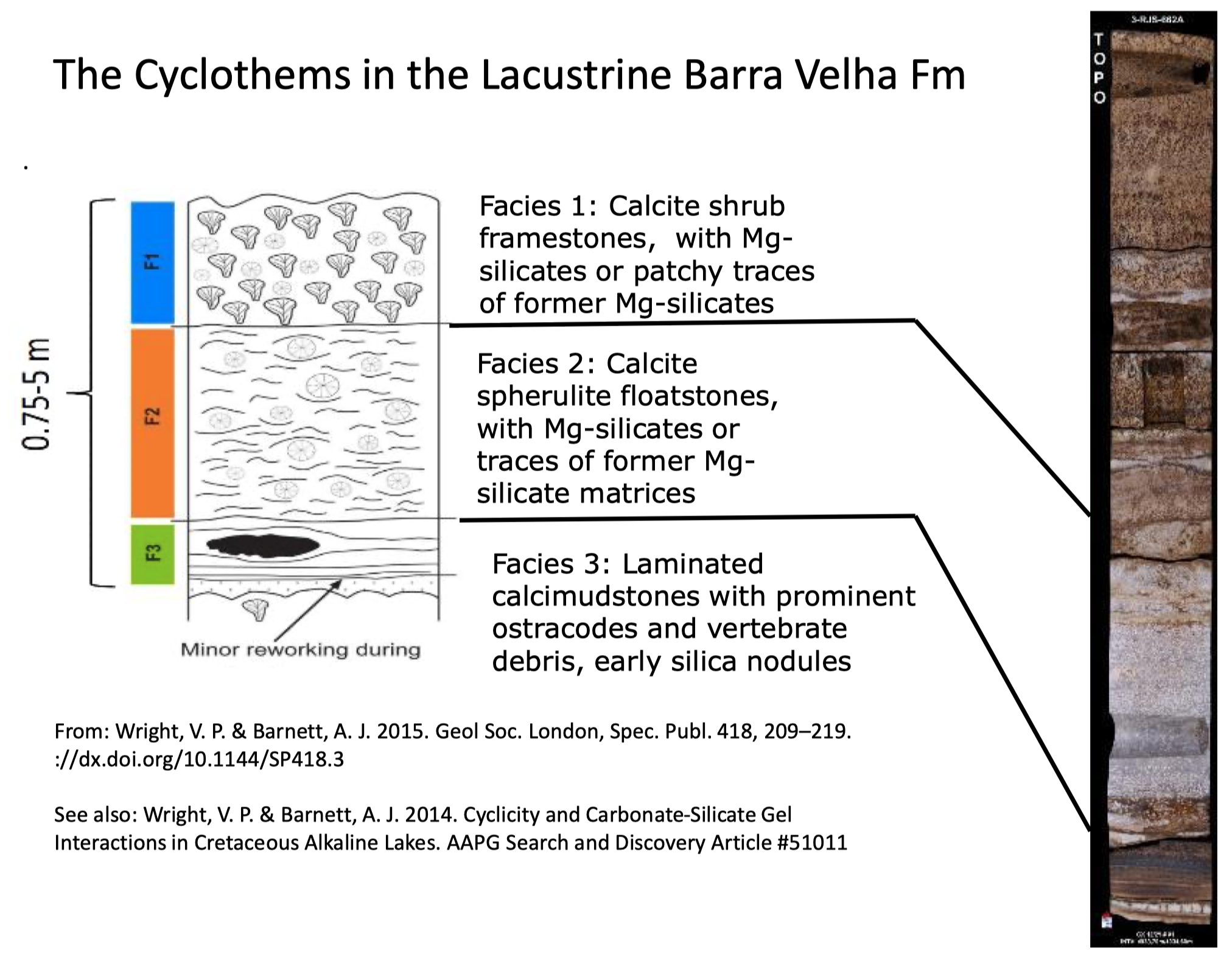
This course provides a description of the highly unusual carbonate reservoirs deposited in the Santos Basin (offshore Brazil) during the rift to sag stages of Atlantic opening, and a discussion of the controversies surrounding their origin. Particular emphasis will be given to the Aptian so-called microbialite reservoirs (Barra Velha Formation and equivalents), reviewing both of the main models for their development and evaluating the seismic and sedimentological models. A practical approach to characterizing these complex rock types will be provided. The course will include an introduction to non-marine carbonate systems in extensional settings, as well as a review of the South Atlantic coquina reservoirs.

Duration and Logistics

Classroom version: A 2-day classroom course. The manual will be provided in digital format and participants will be required to bring a laptop or tablet computer to follow the lectures and exercises.

Virtual version: Four 3-hour interactive online sessions presented over 4 days. A digital manual will be distributed to participants before the course. Some reading is to be completed by participants off-line.

Level and Audience

Advanced. Intended for technical staff and managers who are involved in exploration for or exploitation of carbonates along the margins of the South Atlantic, or are interested in furthering their understanding of carbonate reservoirs in general.

Objectives

You will learn to:

  1. Recognize the range of carbonate systems that develop in extensional settings.
  2. Describe the highly unusual and prolific Aptian carbonate reservoirs of the Santos Basin.
  3. Contrast the models for the formation of these chemogenic rocks and discuss their differences.
  4. Evaluate the strikingly different reservoir characteristics that emerge from the two models.

Key Concepts in Clastic Reservoir Performance (G044)

Tutor(s)

Mike Boyles: Retired Shell Oil; Affiliate Faculty, Colorado School of Mines.

Overview

This course presents the concepts and terms used to describe the sedimentology, stratigraphy and structure of clastic units, and introduces the environments of deposition of clastic sediments. The awareness of these topics and their heterogeneities allows participants to understand their role in predicting reservoir performance in exploration projects, in development planning and in managing field performance.

This course presents a stand-alone overview of clastic reservoirs and would be beneficial for any subsurface team member. It also serves to provide the framework for the geologic concepts that are examined in Clastic Reservoirs Field Seminar: Stratigraphic and Structural Heterogeneities That Impact Exploration and Production Reservoir Performance (G012). Attending G044 will allow G012 participants to maximize the benefit of spending time in the field. For a more detailed approach to the subject in the classroom, consider the 5-day Introduction to Clastic Reservoirs: Stratigraphic and Structural Heterogeneities That Impact Performance (G047).

Duration and Logistics

Classroom version: A 1-day classroom course comprising a mix of lectures (75%) and hands-on exercises (25%). The manual will be provided in digital format and participants will be required to bring a laptop or tablet computer to follow the lectures and exercises.

Virtual version: Two 4-hour interactive online sessions presented over 2 days. A digital manual and exercise materials will be distributed to participants before the course. Some reading and an exercise are to be completed by participants off-line.

Level and Audience

Fundamental. This is a refresher course for geoscientists and an overview of geologic basics for reservoir engineers, petrophysicists, managers and support staff.

Objectives

You will learn to:

  1. Understand the basic terminology of sedimentology, stratigraphy and sequence stratigraphy.
  2. Describe key characteristics of eolian, coastal plain, delta and deepwater reservoirs.
  3. Understand how subsurface reservoirs can be divided into flow units that capture key reservoir flow characteristics.
  4. Describe heterogeneities that can impact flow unit properties.
  5. Understand how sequence stratigraphic concepts are applied in a practical and predictive way.

An Introduction to Mudrock Reservoirs: Basin Setting, Stratigraphy, Sedimentology and Rock Properties (G042)

Tutor(s)

Jeff May: Geological Consultant; Affiliate Faculty, Colorado School of Mines.

Overview

The evaluation of shale reservoirs presents a unique challenge: whereas some of the approaches applied are the same as for conventional reservoirs, many new methodologies and tools have been developed for the assessment of this unconventional resource. In this seminar, participants are exposed to the latest concepts of mudrock sedimentation and how it relates to reservoir properties. The development of mudrock successions, including depositional processes and stratigraphic cycles, is highlighted. Goals of the course include:

  • Providing practical techniques for assessing reservoir heterogeneity during play reconnaissance (‘data mining’) and regional evaluation (‘sweet spot’ mapping).
  • Interpreting and correlating well logs within a sequence-stratigraphic framework.
  • Learning what components are fundamental to core description and interpretation, including observations on composition, texture, sedimentary structures and fractures.
  • Developing an understanding of the factors that control reservoir quality: mineralogy, lithologic components, cements, fabric, fractures and pore systems. Methods used to investigate these rock properties also will be discussed.

Duration and Logistics

Classroom version: A 2-day classroom course comprising a mix of lectures (80%) and hands-on exercises (20%). The manual will be provided in digital format and participants will be required to bring a laptop or tablet computer to follow the lectures and exercises.

Virtual version: Four 4-hour interactive online sessions presented over 4 days. A digital manual and exercise materials will be distributed to participants before the course. Some reading and several exercises are to be completed by participants off-line.

Level and Audience

Fundamental. Intended for all subsurface professionals involved in the evaluation of unconventional resources. Geologists, geophysicists, petrophysicists and engineers who want to understand mudrock deposition relative to reservoir properties will benefit from the concepts and techniques presented. Participants should have a basic familiarity with resource plays. Some understanding of depositional processes and sequence stratigraphy is recommended.

Objectives

You will learn to:

  1. Determine the key geologic parameters that affect the attributes of shale reservoirs.
  2. Identify the components of basin analysis required when scoping a new shale play.
  3. Integrate a variety of data types necessary to identify and map optimum drilling locations and targets.
  4. Evaluate the variety of depositional processes and changes in environmental conditions recorded in a shale succession and tie that information back to well log character.
  5. Assess the basic stratigraphic framework of shale reservoirs and understand how systematic vertical changes relate to fabric, composition, texture and, ultimately, reservoir quality.
  6. Interpret and correlate well logs utilizing a sequence stratigraphic framework.
  7. Understand the observations and methodology necessary when describing and interpreting mudrock cores.
  8. Define the key rock parameters that control reservoir quality and mechanical properties.
  9. Describe the latest methodologies of pore-scale imaging for shale evaluation.

An Introduction to Offshore Seismic Data Acquisition (G041)

Tutor(s)

Malcolm Lansley: Consultant Geophysicist.

Overview

Participants will learn the steps necessary to plan successful offshore seismic acquisition projects and will also learn how to work with contractors to ensure that projects are executed safely and according to plan.

Duration and Logistics

Classroom version: A 1-day classroom course comprising a mix of lectures (90%) and exercises (10%). An optional workshop where a client’s project data may be reviewed can be added. The manual will be provided in digital format and participants will be required to bring a laptop or tablet computer to follow the lectures and exercises. Multiple choice quizzes will be utilized to reinforce learnings.

Virtual version: Two 4-hour interactive online sessions presented over 2 days. A digital manual and exercise materials will be distributed to participants before the course. Some reading and several exercises are to be completed by participants off-line. Multiple choice quizzes will be utilized to reinforce learnings.

Level and Audience

Fundamental. Intended for early career geoscientists and technical support staff who routinely work with seismic data and who would like to manage seismic acquisition projects and interact effectively with data acquisition professionals.

Objectives

You will learn to:

  1. Revisit the fundamental principles of seismic wave propagation.
  2. Review seismic vessel and equipment options for data acquisition and logistics in different marine environments.
  3. Understand key project parameters required to design a successful project.
  4. Review the bid tender process and be able to recommend contract specifications.
  5. Outline a management plan for Health, Safety and Environmental compliance.
  6. Appreciate the importance of employing qualified field QC personnel to ensure the successful completion of data acquisition projects.

An Introduction to Onshore Seismic Data Acquisition (G040)

Tutor(s)

Malcolm Lansley: Consultant Geophysicist.

Overview

Participants will learn the steps necessary to plan successful onshore seismic acquisition projects and will also learn how to work with contractors to ensure that projects are executed safely and according to plan.

Duration and Logistics

Classroom version: A 1-day classroom course comprising a mix of lectures (90%) and exercises (10%). An optional workshop where a client’s project data may be reviewed can be added. The manual will be provided in digital format and participants will be required to bring a laptop or tablet computer to follow the lectures and exercises. Multiple choice quizzes will be utilized to reinforce learnings.

Virtual version: Two 4-hour interactive online sessions presented over 2 days. A digital manual and exercise materials will be distributed to participants before the course. Some reading and several exercises are to be completed by participants off-line. Multiple choice quizzes will be utilized to reinforce learnings.

Level and Audience

Fundamental. Intended for early career geoscientists and technical support staff who routinely work with seismic data and who desire to manage seismic acquisition projects and interact effectively with data acquisition professionals.

Objectives

You will learn to:

  1. Revisit the fundamental principles of seismic wave propagation.
  2. Review equipment options for data acquisition and logistics.
  3. Understand key project parameters required to design a successful project.
  4. Review the bid tender process and recommend contract specifications.
  5. Outline a management plan for Health, Safety and Environmental compliance.
  6. Appreciate the importance of employing qualified field QC personnel to ensure the successful completion of data acquisition projects.

Characterization of Clastic Reservoirs: Workflows for Reservoir Evaluation (G035)

Tutor(s)

Rene Jonk: Director, ACT-Geo Consulting and Training; Honorary Professor, University of Aberdeen.

Overview

Reservoir mapping at production scale has to be performed with an understanding of clastic depositional systems, with full integration of core, core-plugs, well logs, seismic and production and engineering data. The variation in reservoir architecture of most common deposition-system morphotypes strongly influences development and production strategies, as well as in mapping techniques for not only the field scale but also to increase chances of finding near-field opportunities. The workshop examines common reservoir facies in transitional-marine to deep water systems, from fluvio-, wave- and tidal-dominated deltas, incised valleys, deep water channel systems and distributary channel lobe systems (deep water fans). Discussions include dimensional data of sand bodies in the different environments and recognition criteria in cores, well logs and seismic. The class will present optimized workflows for reservoir mapping, including the definition of the deliverables that need to be achieved in different business stages, focusing on when, why and how to develop them.

Duration and Logistics

Classroom version: 3 days; a mix of lectures (55%), core observation (10%) and hands-on exercises (35%). The manual will be provided in digital format and participants will be required to bring a laptop or tablet computer to follow the lectures and exercises.

Virtual version: Five 4-hour interactive online sessions presented over 5 days. A printed manual and exercise materials will be distributed to participants before the course and several exercises are to be completed by participants off-line.

Level and Audience

Advanced. This course is intended for geologists, geophysicists and petrophysicists with basic training in sequence stratigraphy and basic clastic facies.

Objectives

You will learn to:

  1. Recognize different environments of deposition (EoDs) in cores, emphasizing typical facies stacking in common transitional marine and deep marine reservoirs.
  2. Classify facies and stacking in typical transitional marine to deep marine EoDs.
  3. Mechanisms for sediment transport in different EoDs and impact on reservoir rock properties.
  4. Integrate core and core plug information in reservoir analysis, tying to well log and seismic data.
  5. Recognize typical log patterns in different depositional systems.
  6. Recognize typical seismic map views and cross-sectional views of sand-rich EoDs.
  7. Apply mapping techniques for well logs and seismic with emphasis on identification of EoDs.
  8. Make pre-drill predictions based on understanding of EoDs and seismic response.
  9. Understand dimensional data for sandbodies in different EoDs
  10. Implement reservoir mapping workflows that emphasize data integration and focus on deliverables in different business stages.

Introduction to Clastic Reservoirs: Stratigraphic and Structural Heterogeneities that Impact Performance (G047)

Tutor(s)

Mike Boyles: Retired Shell Oil; Affiliate Faculty, Colorado School of Mines.

Overview

This is a 5-day in-depth introduction to clastic reservoirs, with a focus on stratigraphic and structural heterogeneities that impact reservoir prediction and production. The course will benefit any subsurface team member that is concerned about how variations in the geology might impact reservoir performance. Taking this course will allow one to better interpret subsurface data sets and outcrop exposures, resulting in a better understanding of the impact of stratigraphic and structural heterogeneities on reservoir performance.

It is recommended that you take this class before taking Clastic Reservoirs Field Seminar: Stratigraphic and Structural Heterogeneities That Impact Reservoir Performance, Colorado and Utah (G012) in order to make better outcrop observations and understand the terminology used in field discussions. This will maximize the benefit of time spent in the field for G012 participants.

Duration and Logistics

Classroom version: 5 days; a mix of lectures (75%) and hands-on exercises (25%). The manual will be provided in digital format and participants will be required to bring a laptop or tablet computer to follow the lectures and exercises.

Virtual version: Five 4-hour interactive online sessions presented over 5 days. A digital manual and exercise materials will be distributed to participants before the course. Some reading and several exercises are to be completed by participants off-line.

Level and Audience

Fundamental. It is a background course for subsurface team members to teach geologic basics that are often missed when predicting/understanding reservoirs. These basics can be applied to better predict reservoir performance for estimating reservoir productivity in exploration projects. It also allows for better field development planning and provides understanding of conformance issues within an existing field.

Objectives

You will learn to:

  1. Understand detailed facies analysis within deposits of wave dominated deltas, fluvial dominated deltas, fluvial systems, tidal/estuarine, eolian and turbidites.
  2. Recognize key facies in cores and logs.
  3. Use depositional models to make better reservoir geometry predictions.
  4. Divide subsurface reservoirs into flow units that capture key reservoir flow characteristics and heterogeneities at a variety of reservoir model scales.
  5. Communicate and discuss flow unit properties with subsurface team disciplines.
  6. Use key sequence stratigraphic concepts in a practical and predictive way.

Applied Concepts in Fractured Reservoirs with Discussions on Production, EOR, CO2 Sequestration and Geothermal Energy (G039)

Tutor(s)

John Lorenz: Co-founder and Partner, FractureStudies LLC.

Scott Cooper: Co-founder and Partner, FractureStudies LLC.

Overview

This course explores the wide range of structures that fall under the term ‘fracture’ and examines the effects of different fracture types on permeability in conventional and unconventional hydrocarbon reservoirs, and for EOR, CO2 sequestration and geothermal energy applications. The course establishes an understanding of natural fractures by explaining fracture mechanics and the origins of fractures, and then presents practical approaches to analyzing and working with fractures. Topics will include: collecting fracture data; measuring fracture attributes; differentiating natural from induced fractures; calibrating fracture data (from core, CT scans, outcrops, image logs and seismic); and determining in situ stresses. The course also describes how to predict fracture types in different structural domains and in different types of reservoirs, how the differences between extension and shear fractures control both individual fracture permeability and fracture network interconnectedness, and how to assess the interaction between natural and hydraulic stimulation fractures. Discussions of the applications to CO2 sequestration, geothermal energy, hydrocarbon reservoirs and enhanced recovery are included.

Duration and Logistics

Classroom version: A 3-day classroom course comprising a mix of lectures (80%) and hands-on exercises (20%). The manual will be provided in digital format and participants should bring a laptop or tablet computer to follow the lectures and exercises. A highlight of the classroom version is the inclusion of a hands-on, 65-plus piece teaching collection of natural and induced fractures in core.

Virtual version: Five 4-hour interactive online sessions presented over 5 days. A digital manual and exercise materials will be distributed to participants before the course. Some reading and exercises are to be completed by participants off-line.

Level and Audience

Advanced. Intended for geoscientists, reservoir and completion engineers, and petrophysicists, who wish to characterize and understand fracture systems and their effects on reservoir permeability and fluid flow. The class includes assessing how fracture permeability is affected by the in-situ stress system, and the interaction of natural fractures with hydraulic stimulation fractures.

Objectives

You will learn to:

  1. Appreciate how different fracture types have different effects on reservoir permeability and fluid flow.
  2. Assess how fracture types can vary by lithology within the same structural setting.
  3. Establish how fracture types can vary by structural setting within the same lithology.
  4. Assess fracture permeability and how it can be sensitive to changes in the in-situ stress during production and injection.
  5. Recognize fracture type using the small sampling of a reservoir offered by core and how this can provide a conceptual model for differentiating radial from anisotropic drainage, or flow away from the well during injection.
  6. Appreciate the interaction of natural fractures with hydraulic stimulation fractures as utilized in hydrocarbon, sequestration and geothermal industries, depending on fracture type and orientation relative to the in-situ stresses.
  7. Use insights into fracture mechanics and the origins of fractures, and gain an understanding of natural fractures and their potential effects on fluid flow.