


Tutor(s)
Bob Krantz: Consulting Geologist and Adjunct Professor, University of Arizona.
Peter Hennings: Research Professor, UT Austin, Texas.
Overview
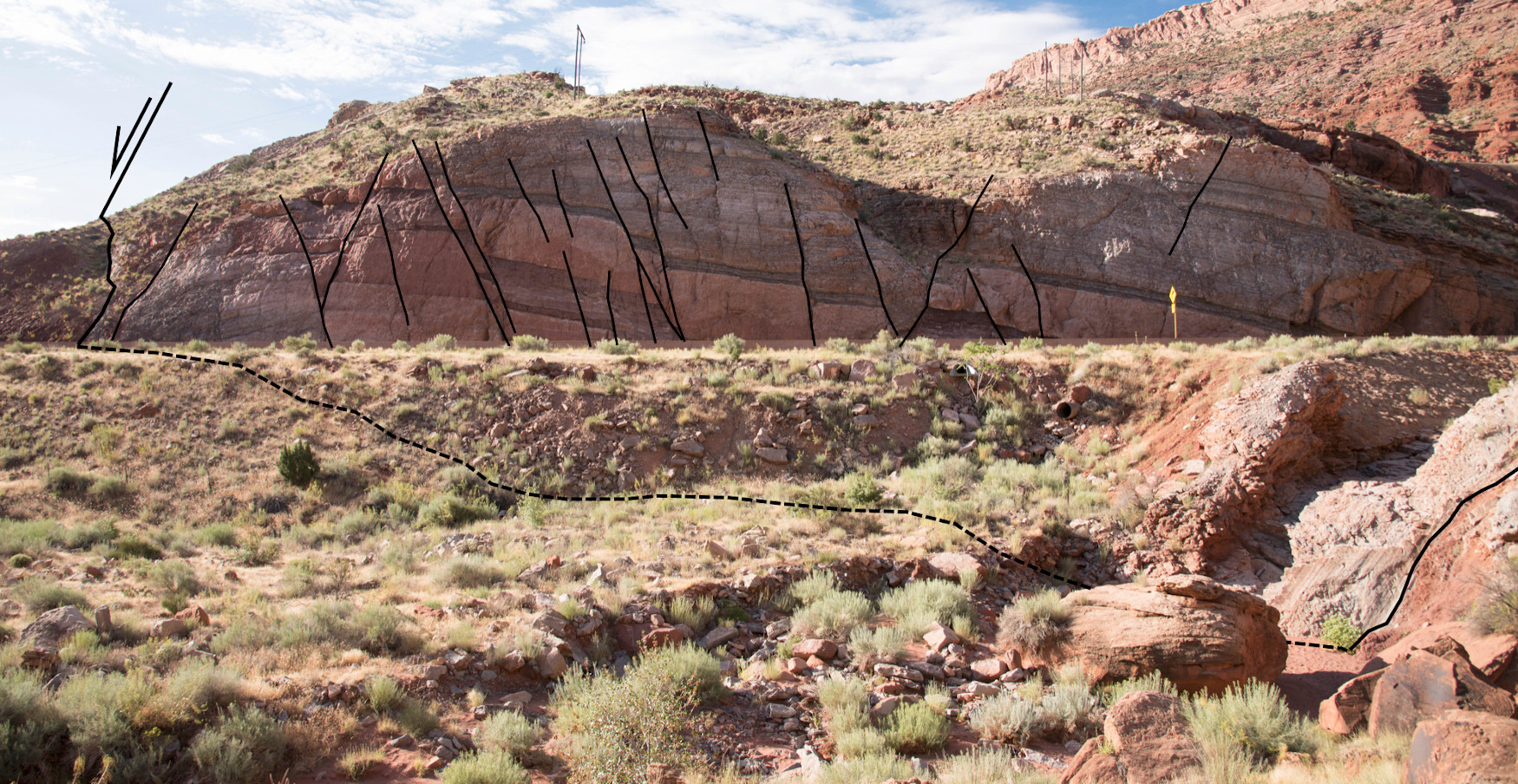
Trap analysis for exploration risking and field management requires complete 3-D characterization, especially where faults are critical elements. The ability of faults to seal and leak can vary in space and over geologic and field management timeframes. Explorationists and development geologists must understand fault characteristics, integrate appropriate data and perform specific analyses when working with faulted reservoirs. The Moab fault system and surrounding geology provide exceptional examples of trap-scale structures with fault zone characteristics that vary depending on offset and juxtaposed rock type, which are documented to have both sealed and leaked over geologic time in patterns that are clearly expressed. Reframing these outcrops to subsurface application is immensely valuable in understanding static and dynamic reservoir behavior.
Duration and Logistics
A 6-day field course comprising a mix of classroom lectures (30%), practical exercises (20%) and field visits to some of Earth’s best-exposed and thoroughly studied outcropping fault systems (50%). The manual will be provided in digital format and you will be required to bring a laptop or tablet computer to the course. Laminated posters will be used extensively in the field for annotation and discussion. The course is based in Moab, Utah, with participants arriving in and departing from Grand Junction, Colorado.
Level and Audience
Advanced. This course is intended for geoscientists and reservoir engineers who work with layered faulted reservoirs. Participants would benefit from having a basic familiarity with structural geology.
Exertion Level
This class requires a MODERATE exertion level. The fieldwork will involve walking up and down slopes over rough ground. There will be walks of up to 1.6km (1 mile) on most days, the most strenuous being an ascent (and descent) of 60m (200 ft) over rocky ground as part of a 3.2km (2-mile) walk. The altitude of the field area ranges from 1200–1750m (4000–5800 ft), which may lead to unexpected shortness of breath for some. The weather should be pleasant with typical highs of 27°C (80°F) in the fall, but early morning temperatures may be below 5°C (40°F) on some days. Transport will be by mini-van or SUV on paved and graded dirt roads.
Objectives
You will learn to:
- Understand how normal faults form, displace and link in 2-D and 3-D.
- Understand how fault systems evolve over geologic time.
- Characterize controls on mechanical stratigraphy.
- Identify fault zone deformational fabrics and mechanics.
- Understand static and dynamic fault seals, fault permeability and seal effectiveness.
- Develop reservoir compartmentalization models.
- Predict fault reactivation likelihood for application to seal failure and induced seismicity.
- Apply 3-D fault framework interpretation methods.