


Tutor(s)
Richard Jones: Managing Director, Geospatial Research Ltd.
Overview
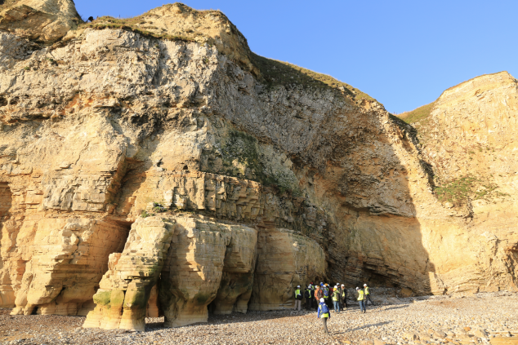
This course is framed around demonstrating the principles of CO2 storage capacity and risk elements of a prospective CCS play. Starting from basic geoscience principles, the course focuses on reservoir capacity estimation, injectivity and containment risks. The principles will be illustrated using well-exposed outcrop examples from NE England including clastic reservoirs from a variety of depositional settings (typically Carboniferous, Permo-Triassic, or Jurassic), sealing lithologies (mudrocks and evaporites) and structural controls on reservoir connectivity and containment (fractures, juxtaposition and fault zone complexity).
Duration and Logistics
A 5-day field course with fieldwork and practical sessions supported by classroom lectures. The course will be based in the historic city of Durham in NE England with easy access to coastal and inland locations in the counties of Durham, Northumberland and Yorkshire.
Level and Audience
Fundamental: The course is intended for subsurface scientists, including geologists and engineers, with a knowledge of petroleum geoscience, who are working on or new to, CCS projects.
Exertion Level
The course requires an EASY exertion level. Outcrops include coastal outcrop sections and inland exposures all with easy access. There will be some walks along beaches and easy paths to get to the outcrops with a maximum distance of around 5km (3 miles) or less, elevations vary from sea level to up to 500m (1600 ft). Temperature variations in late spring and summer are typically between 10 and 25°C (50–80°F).
Objectives
You will learn to:
- Characterize a variety of reservoir types (considering potential impacts of stratigraphic, depositional and structural heterogeneities, porosity and permeability) with respect to their suitability for carbon capture and storage.
- Estimate reservoir capacity through stratigraphic and structural analysis, and porosity estimation.
- Understand fluid transport parameters – injection/flow rate and reservoir permeability.
- Assess containment potential for CO2 (evaporitic and shale seals, faults and fractures).
- Evaluate fracture networks with respect to storage capacity, injection rates and containment risk.