World-class training for the modern energy industry

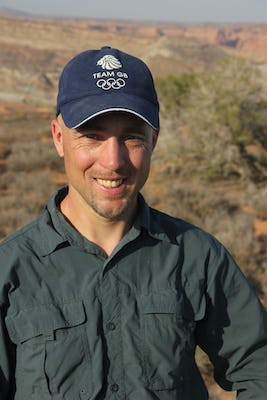
Meet the Expert: 5 Minutes with Alex Bump

We sat down with Alex Bump ahead of his upcoming GeoLogica course: Geologic Carbon Storage for Geoscientists and Engineers

What’s your field and specialisation?

My background is structural geology and tectonics. I have worked in petroleum exploration and my current field is CCS. At heart I am an explorer, wanting to know what’s over the horizon and how things work.

“If you drill here, what are you going to find?”

“How does this work as a system?”

“How do I put ranges on what I’m likely to find?”

“What is the performance likely to be using minimal data?”

I bring the eyes of an explorer to CCS thinking.

Tell us a bit about your teaching journey.

I started teaching geology as a grad student 30 years ago . . . and, at first, I was terrible at it! But I wanted to be good, so I watched good teachers and I read about it, studied it and was fortunate to work with some really excellent instructional designers. I went on to teach courses for BP, the University of Arizona, members of the public, and I’ve continued teaching different audiences and subjects at the University of Texas.

What is your favourite memory from fieldwork or field training?

You know, I’m hard pressed to identify a particular favourite, but I’ve got a collage of wonderful memories of being high in the mountains, gazing out over a valley of beautifully structured geology, just pinching myself that I actually get paid to do this stuff! And, you know, I’ve described this job sometimes as getting paid to go play in the mountains and solve puzzles. And those are the days when there is no better job in the world.
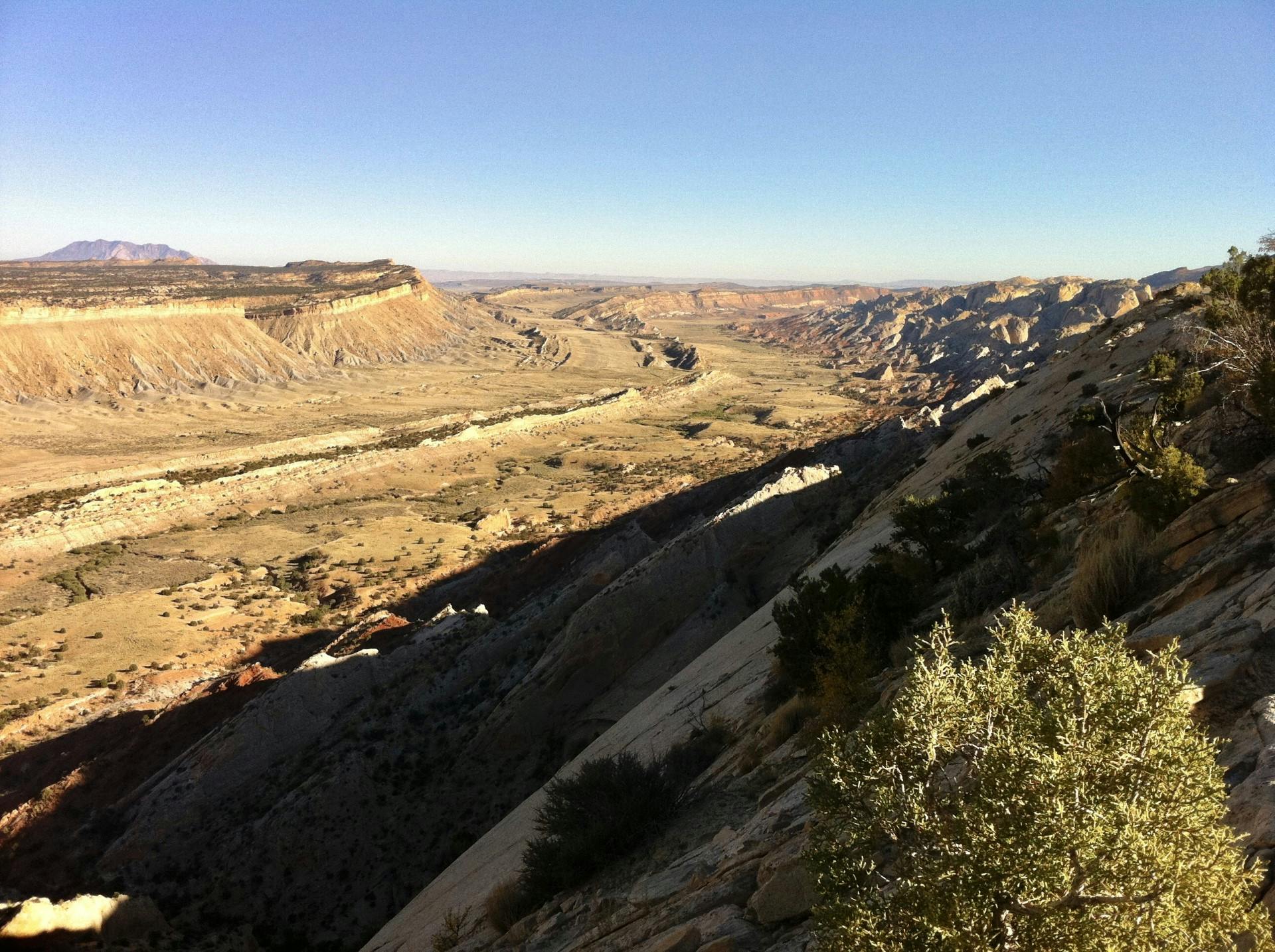
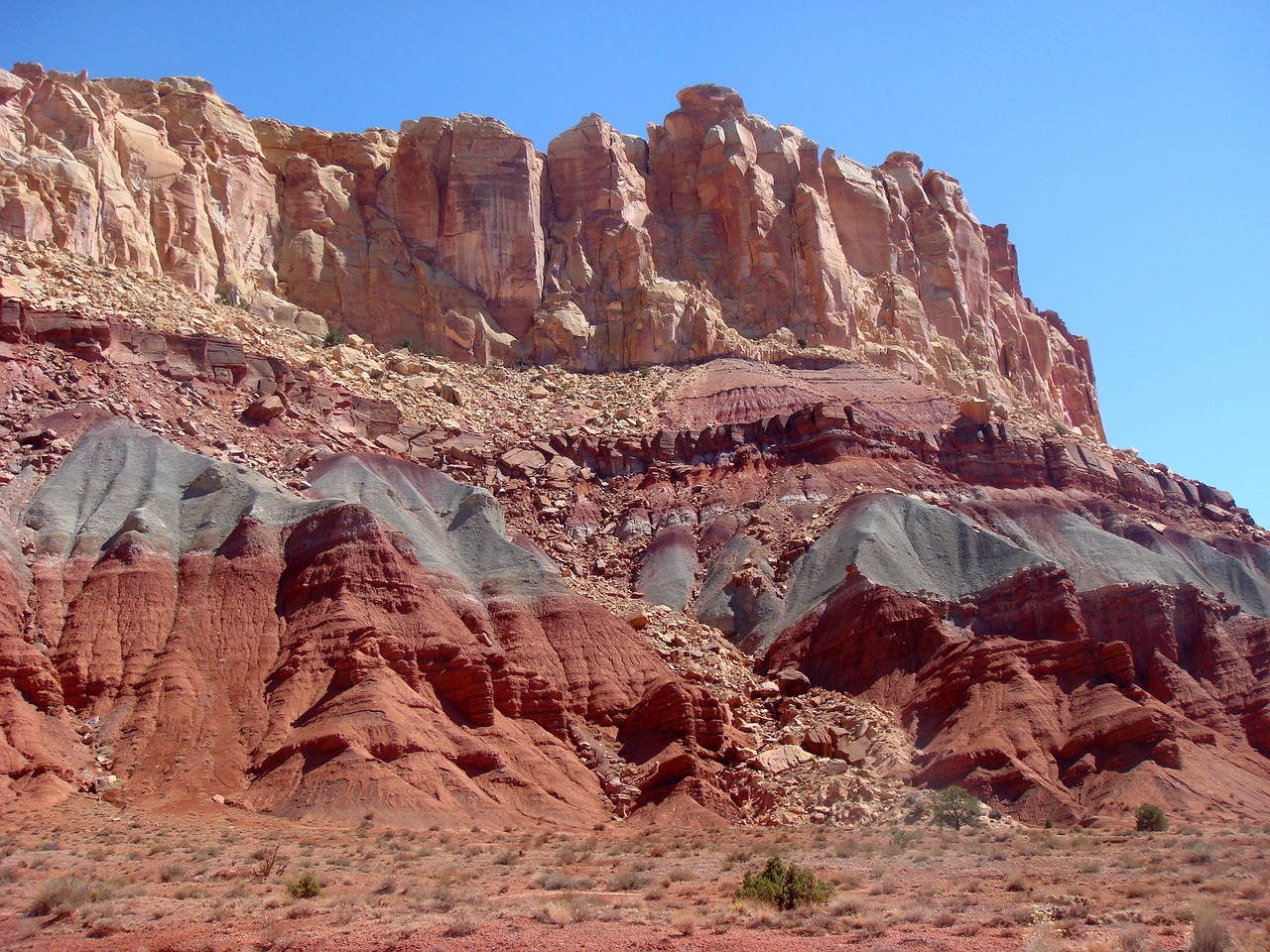
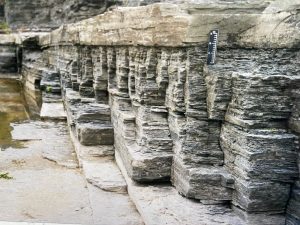
Cretaceous strata of the Waterpocket Fold in Capitol Reef National Park, Utah

Tell us about your upcoming course with GeoLogica – what is it about and who is it for?

The course is about the subsurface aspects of CCS, the geologic components of CO2 storage, and it’s effectively trying to adapt petroleum expertise for CCS. It’s aimed at geologists, geophysicists and engineers. It’s part geology, part modelling, part surface monitoring.

My understanding initially, coming from petroleum geology, was that CO2 seems fairly simple: it’s a buoyant fluid and we’re talking about subsurface fluid flow with reservoir seals and traps. How different can it be? And the answer is actually really different. First, you’re injecting at industrial rates, so pressure build-up is a major constraint. Second, the economics are very different. It’s a low-margin business, so you’re far more constrained than when dealing with petroleum. And third, you don’t want it back. The goal is sequestration, which opens up a whole new series of plays and concepts that work, and also risks. So all together, these components ripple through the entire system and make you rethink all your ideas of what ‘good’ looks like.

Tell us a fun fact about yourself that most people don’t know?

Outside of geology I am a lifelong endurance athlete, woodworker, dad and caffeine addict by necessity!

What would you say is the biggest challenge facing your sector at the moment as a whole?

Oh, that’s a good question. You know, as much fun as I have working on the subsurface, as much room as there still is to optimise subsurface geology, and as much of a need as there is for geoscience, the big barriers to CCS are above ground. In different parts of the world, it varies a little bit, but it’s a combination of economics, permitting and public acceptance.

In the US, the economics have radically shifted over the last couple of years so that is no longer the big barrier – now, it’s public acceptance and permitting. These things will get worked out eventually but it’s early days and a new industry. The public is unfamiliar with it and are – fairly enough – distrustful. Permit and regulators are new to this game and are, again, proceeding with appropriate caution. But those are the big barriers in the US. In other parts of the world, economic incentives vary dramatically and so, in those countries, economics is the primary barrier. But if you find a way to pay for it, then the other things become much more significant.

I grew up in New England, one of the oldest parts of the US, where you commonly see farmhouses that are a couple of hundred years old. Behind every one of those farmhouses, like the one where I grew up, there would be a pile of rusting cans and bottles, which harks back to an age when municipal trash collection was unheard of. And it actually wasn’t very long ago – say 50–60 years. But nowadays, municipal rubbish collection is almost taken for granted. And that was, in some ways, the first step in a journey toward pollution control. It continued with cleaning up the general practice of dumping industrial waste into the nearest waterway. In the US, the Queen Water Act of 1974 started the era of underground injection of hazardous waste, and that has continued, right? We’ve cleaned up sulphur dioxide emissions and chlorofluorocarbons – the sources of acid rain and ozone degradation. In some ways, CCS is just the next step in this journey, of realizing the impact of widespread dumping of CO2 into the atmosphere. And, you know, just like those other things, there is a learning curve and a public acceptance curve and a remuneration curve that all has to come together before it works at scale – this takes time. We’re low on that curve in CCS but you can see the day coming when it’s simply a routine part of doing business.

What would be your advice to geoscientists who are starting their careers?

I gave this one some thought and I would say, “Learn to think in terms of systems but learn to talk in terms of stories.”

Geology is governed by a fairly simple set of processes. There are lots of processes at work and they can combine in complex ways. So, by stepping back and thinking in terms of systems, you’ll be a much stronger interpreter. Think “How does the system work here?”, but also think about how you link the observations you make to an outcome via reasonable geological processes. So, it’s thinking about systems, linking the observations with a story that incorporates reasonable geologic processes, and that is a powerful QC on interpretation.

With regards to talking in terms of stories – scientists think in terms of facts, but people communicate in terms of stories. Those who talk in terms of pure facts tend to lose their audience. So, learning to tell stories is a really powerful way to connect with an audience and communicate research in a way that lands. It’s critical: brilliant research routinely falls flat because it simply wasn’t intelligible to the audience or didn’t connect with them.

Give us your best/worst geology joke?

Q: Why was the sandstone so cheap?

A: It was on shale!

That is truly awful.

Well, when you start telling geology jokes, you really know you’ve hit rock bottom.


Geologic Carbon Storage for Geoscientists and Engineers by Alex Bump, Seyyed Hosseini and Katherine Romanak will be running from 23-27 September 2024.
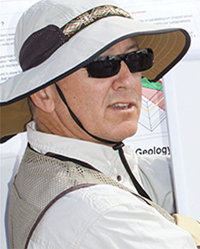
Meet the Expert: 5 Minutes with Russell Davies

We sat down with Russell Davies ahead of his upcoming GeoLogica course – Structural Styles and Fault Characterization in Exploration and Production, Moab, Utah


What is your field and specialization?

I’m a structural geologist with over 30 years’ experience, working primarily in oil and gas after completing my PhD in structural geology from Texas A&M University.


How did you get into teaching?

It came about naturally. I started my career at Shell in Exploration and Development in New Orleans working the Gulf of Mexico. Three years in, I realized I wanted to get into more of a technology group. So, I left Shell and joined the structural geology technical team in a company called Arco in north Dallas. In the technology group at Arco, you were an in-house specialist and, as such, you were expected to apply your expertise to projects internally but also educate, so you were assigned a course to develop. One of the courses I developed was the Moab Fault Seal outcrop-based course I am teaching for GeoLogica. I started teaching it in the mid-90s and, when I left the company, after ARCO was bought by BP in 2000, I joined Rock Deformation Research, a small structural geology consulting company based in the UK and was able to take the course with me as I owned the IP and continued to offer the course. At Rock Deformation Research I started to develop more classroom courses, too, primarily with a fault seal focus. When I moved to Schlumberger, I worked with their training division and taught similar courses to clients worldwide.


What do you enjoy most about teaching?

Well, not the students! [wisecrack]

What do I like? Well, there are a couple of things I really like. When you’re teaching a training course, it can be a bit boring because, in a way, you’re teaching the same thing. So, I try to modify what I’m teaching a little bit each time. To do that, I take the reviews from previous courses, the sense of what worked and what didn’t work, how the students reacted and how smoothly it went as it forces you to stay on top of the field and the literature and things like that. You don’t want to be teaching the same course 20 years later – you’d be talking about 20-year-old concepts – science moves forward. For me, staying current and on top of recent developments is important and something I enjoy.  I try to stay dynamic and often modify the course on the fly depending on the group interest and questions.

The other aspect I particularly enjoy is mentoring. I didn’t appreciate how important it was when I was younger. When you are younger and building a career, you’re looking to see where you fit; you’re looking for openings; you’re trying to move forward in the race. As you get older, you realize there’s really nothing to build, so mentoring becomes extremely important. Not just in terms of teaching but also in terms of working with younger professionals. I have been very lucky in my career, but I think it’s quite difficult for somebody young now to get the kind of career I have had – to have the same opportunities in terms of research, field work, consulting services and working for major oil and gas companies, service companies and small consulting companies. So, I most enjoy mentoring, teaching and the transfer of knowledge.


Can you tell us about a favorite memory from fieldwork or field training? 

Well, I’ve run many, many courses in my time and done loads of field work – it can feel like a bit of a blur – but there are still lots of experiences I’ve had that are unique. I mean one of them was I had an opportunity to go on a field trip and camp in the desert in Oman, which was just amazing. Our fieldwork party consisted of about fifteen Westerners and fifteen Omanis, vehicles with drivers and a big food truck, and we just took off down the main road heading southwest and then turned north into the desert across the sand. I remember vehicles getting stuck in the sand and having to push them out. They put up a big tent that served as a dining hall and as a mosque for the Muslims to pray. And then you camped outside on cots that they brought in. Three days in we were eating tuna steaks and French fries in the middle of the desert – certainly a memorable experience!

On another occasion I remember a trip to Muddy River in Utah with Janok Bhattacharya and sitting there just eating lunch on a clear day. We got caught in a sudden rainstorm and I was on one side of the Canyon and Janok was on the other. I remember watching Janok across the canyon trying to get under a under a rock overhang to avoid the rain. But what he didn’t realize was that that there was a sort of mini waterfall that came through behind the rock. And when I saw him next, he was absolutely covered in mud!

With so many years and experience in the field I am not sure what triggered these two memories.

Source: Russell Davies


Tell us about your upcoming field course with GeoLogica?

Well, the focus of the course is faults, and it is designed for petroleum geologists or geoscientists, whether that’s geologists, geophysicists or reservoir engineers. Oftentimes in their work they’re trying to understand what controls the hydrocarbons staying in place. With hydrocarbons being lighter than water, they’ll just continue rising to the surface if nothing traps them, so they need something that stops their flow laterally and vertically with a seal (a layer of shale) that’s impermeable for all intents and purposes. Laterally and vertically, you need to have confinement from seal layers with a shape like an upside-down bowl. And if you don’t have that, you could have a fault which can then act as a barrier to lateral flow. So, a lot of the course talks about methods and techniques to evaluate that seal in the subsurface with a focus on fault seal.

One problem with collecting data in the subsurface is resolution. We might collect well data, for instance, that’s at a high-enough resolution, but has no lateral information away from the well bore. Seismic data has lateral extent but doesn’t capture the higher resolution stratigraphy and structure. The nice thing about the field course around Moab, Utah, is that there are some very nice exposures of faults and associated deformation at a range of scales that are excellent analogs to the subsurface where the resolution is inadequate. You can look at the deformation along a fault, think about the processes that led to that formation, and then think about the tools that we have in the office to evaluate it in the subsurface. Seeing the formations in person allows you to consider the strengths and weaknesses of those tools and methods, because invariably they don’t capture exactly what’s there. What’s particularly nice about the faults near Moab is that there is enough displacement across the fault at a scale at which you would see those faults on seismic but here you get to touch them and you can see how wide they are, what the deformation mechanisms are and we also look at some of the geometries of how the faults connect together in a lateral sense. There are other areas around the planet that have some of those characteristics, but I know of no place that has all of them in one place. That’s one reason why geologists are falling over each other out there – it’s such a spectacular spot for learning about structural geology.

The fault seal field course around Moab is relevant for anybody thinking about those sealing characteristics and characterizing faults in the subsurface. Historically that would have meant petroleum geologists working for petroleum companies but in the last three to five years, I’ve also been applying it to CO2 containment and incorporate some of these concepts into the training.

In terms of the level of expertise, the people who get the most out of the course are those who’ve already asked the questions about fault seals. It’s probably more of an intermediate/advanced level course, although I do think that even somebody relatively junior would get something out of it – it would inform them of the key issues and things to think about.

I am not only teaching the outcrop-based training in Moab with GeoLogica but also offer classroom training on fault seal and can modify the courses to meet a company’s needs, which I have done frequently in the past.


Can you tell us a fact about yourself that most people might not know?

I guess one thing would be that I’m an immigrant to the United States. Even though I speak like an American and even though I’m very red, white and blue, my family immigrated to the United States when I was 11 from South Africa (like Elon Musk). As a kid I used to drink a lot of tea with milk and eat a lot of Marmite on toast and sardine sandwiches (not together) – something that the other kids in school used to tease me about! I also took speech lessons because I had a lisp. I remember telling the teacher, ‘I want to speak like a real American!’ So, sure enough, I changed my accent and that helped me integrate more fully.  It took me about 40 years before I ever went back to SA, and I’ve only been back once since moving in 1969. I don’t have strong ties to SA; we moved to Ohio to begin with, so I’d say I’m more Midwestern American than anything else.


What would you say is the biggest challenge to the oil and gas sector at the moment?

I mean, they seem to be doing quite well, right? If anything, they’re probably not being challenged enough. All the major oil and gas companies are doing well, Saudi Arabia’s doing extremely well. The reality is that we’re still tied to oil and gas and will be for a long time.

Public pressure to reduce our reliance on carbon energy sources is important. But there is a tendency to think that we would move very quickly – that we can just turn it off and immediately shift to something else. Well, if you want to see a huge crash of world economies and mass starvation then sure let’s do that . . . but I certainly do not. With that said, if anything, big oil isn’t being challenged enough. Companies are still given too many opportunities to drill in places that they shouldn’t, in areas which should be protected to maintain some areas of wilderness. Oil and gas companies are too often protected from lobbyists. But, at the same time, they have given me my career and I’m very bullish about oil and gas – we can’t just ‘turn off the spigot’.

I don’t even think we should stop exploration. A few years ago, companies talked about doing only development (i.e. no more exploration). Well, look at Germany – from a security perspective alone, you have to have your own energy sources. And oil and gas, for the moment, has to be your main energy source.

However, we’re probably not moving fast enough and there are too many people who dismiss the threat of global warming/climate change. But I don’t know what the answers are. Personally, I don’t think that there’s a huge threat to the oil and gas sector, as such, because there is still a need for us to keep producing the stuff!


What would be your advice for junior geoscientists joining the industry in 2024?

It’s a difficult question because the field has changed so much – not because geologists and geoscientists are changing it, but because of the way new technology is being driven by AI. It’s a shame. I’ve been lucky to spend as much time as I have looking at rocks in the field for research and also teaching. And I think that is important. I would suggest young geoscientists continue as best they can to maintain geology fundamentals, whether that’s structural geology, sedimentology, petrophysics, whatever it might be, because there’s a tendency to lean too much on the technology. There’s a tendency to sit in front of a computer and let the computer generate results – to think that AI or machine learning is a solution now for everything. I have seen corporate managers pushing technology because they see it as the future, and professionals who don’t fully understand what the technology is, what it does, what it is good for, what it isn’t good for, resulting in poor or unnecessary solutions using the wrong tool for the problem. That is the trap you get into. I would often see professionals relying on software to generate results but couldn’t tell the result was wrong. Sometimes the results would be orders of magnitude off. The problem is that they’d lost the fundamentals. So, the one suggestion I would make is don’t lose track of the fundamentals. If you don’t have the fundamentals, you’re going to train the AI incorrectly and it’s going to give you the wrong results. So, while AI and machine learning are very powerful tools, you’ve just got to be careful.

And, finally, take any opportunity you can to get back into the field. I admit this can be difficult because many companies aren’t as willing to invest in training as they used to but take it if you can.


Natural Hydrogen: A Golden Moment for the Energy Transition?

Hydrogen is the simplest possible molecule yet it is set to have a prominent role within future energy scenarios, predominantly driven by its ability to store and deliver usable energy.

In the UK, there are plans to develop a number of projects with hydrogen production and industrial usage, coupled with CO2 capture and storage. These will be driving the sustainable development of a future hydrogen economy but are clearly impacted by the need for hydrogen to be industrially produced, either by steam-methane reformation (blue hydrogen) or electrolysis (green hydrogen). There is, however, much recent discussion about all that is gold – natural hydrogen. This is produced naturally underground and is something that could be explored for and produced as we have done so for oil and gas.

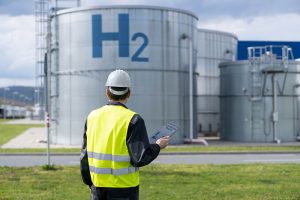
Hydrogen tank and worker

The last few years have seen a growing interest in natural hydrogen accumulations, in particular surface seeps and expressions (often referred to as fairy rings), and how much hydrogen could potentially be stored naturally in subsurface reservoirs. Hydrogen-rich gas seeps have been known about for thousands of years. Perhaps the most famous and well documented continuously burning natural gas seep is at Chimaera, near Antalya in Turkey, that has up to 12 per cent hydrogen content. Near the Malian capital of Bamako, Hydroma Inc. have identified a number of hydrogen-bearing reservoirs capped by a dolerite sill. Ninety-eight per cent pure hydrogen is produced from the subsurface and it now generates electricity for a local village using a fuel cell driven by the produced hydrogen. More recently Helios Aragon in Spain confirmed the presence of natural hydrogen at an old oil and gas well, and has plans to explore it further with the ultimate aim of producing hydrogen commercially. Meanwhile, recent drilling by Gold Hydrogen Ltd on the Yorke Peninsula near Adelaide found natural hydrogen up to 86 per cent purity and the future goal is also commercial production.

So, it appears that the subsurface could potentially hold large volumes of stored natural hydrogen. But, how is it produced? This is a key question that has several possible answers. We know that there are both non-biological and biological processes that can lead to hydrogen being produced in the Earth’s crust. It can be made by microbes living in the crust, in addition to geological processes, such as serpentinization, where the mineral olivine is weathered to form hydrogen-rich fluids. Other geological processes include iron reduction, where iron-rich minerals are reduced to ferrous iron and hydrogen sulphides.

hydrogen symbol in blue

There is clearly much still to understand about the way natural hydrogen is produced in the subsurface, as well as how much is present and where these accumulations are. Commercial exploitation will also need to assess the engineering challenges for extracting this hydrogen and how it can be utilized as part of the changing face of our modern energy landscape.

GeoLogica continues to offer courses focusing on the hydrogen within the energy transition, with two new courses on offer in 2024:

The Hydrogen Landscape: Production, Policy and Regulation (E575) gives an in-depth overview of the current hydrogen landscape, including its likely role in the energy transition, production and economic challenges.

The Transportation and Geological Storage of Hydrogen (E576) explores the need for geological storage of hydrogen and the geological storage options available for the secure storage and withdrawal of hydrogen from these different geological stores.

If you’re interested in joining the hydrogen debate, want to learn more about natural hydrogen, or simply discover the role that hydrogen can play in decarbonizing our energy systems, then GeoLogica has a training course for you – find out more here!

Canyonlands, Arches and even a Dead Horse . . . Utah Rocks!

This year GeoLogica will be running a number of field courses in Utah, in particular to the region around Moab and incorporating classic areas in Arches and Canyonlands National Parks, as well as Dead Horse State Park and well known localities such as Onion Creek, Bartlett Wash and Delicate Arch. Field course participants will have the opportunity to study a variety of geological disciplines, including stratigraphy, sedimentology and structural geology. But why is this area so attractive to geological field groups and what makes us return year after year to explore the geology of the region?

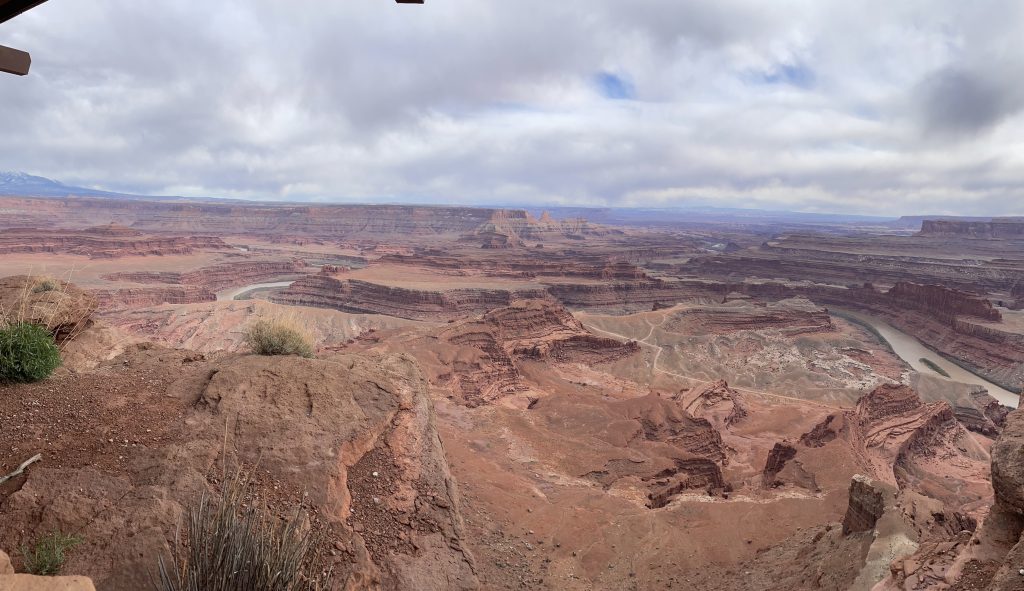
For those of us who are lucky enough to have visited southeast Utah, it’s difficult not to be inspired by the natural beauty of the area, even if you aren’t a geologist. The rocky and dry terrain displays a palette of colours, shapes, shadows and vistas that are hard to rival. The dry air, deep blue sky and often snow-capped summits of the La Sal mountains are guaranteed to impress. For the geologists among us, the Paradox Basin preserves some classic, text-book geological features that appeal to the academic as well as the applied geologist, whether exploring for mineral resources or hydrocarbons. Field excursions should always include the spectacular view from Dead Horse Point, where the Colorado River has cut down into the bedrock of the Colorado Plateau. Cliffs of over 1500 feet preserve a wonderous collage of sedimentary rocks, including shallow marine deposits of the Honaker Trail Formation, through mixed marine and terrestrial sequences of the Cutler Formation, up into aeolian and fluvial sequences of the Wingate and Kayenta Formations, to name but a few.

Dead Horse Point in Canyonlands Utah
Panorama of Dead Horse Point, Canyonlands National Park

Salt tectonics and salt-sediment interactions are one of the top outcrop phenomena preserved in the landscape and they offer a window into analogous salt basins worldwide and the effects of salt diapirism. Of equal importance are the outstanding exposures of faults and structural geology features, like the classic Moab Fault and relay ramps of Canyonlands National Park. These offer an additional opportunity to focus on specialist topics, such as fault seal, fault rocks and smaller scale features such as deformation bands.

Panorama of Delicate Arch in Arches National Park Utah
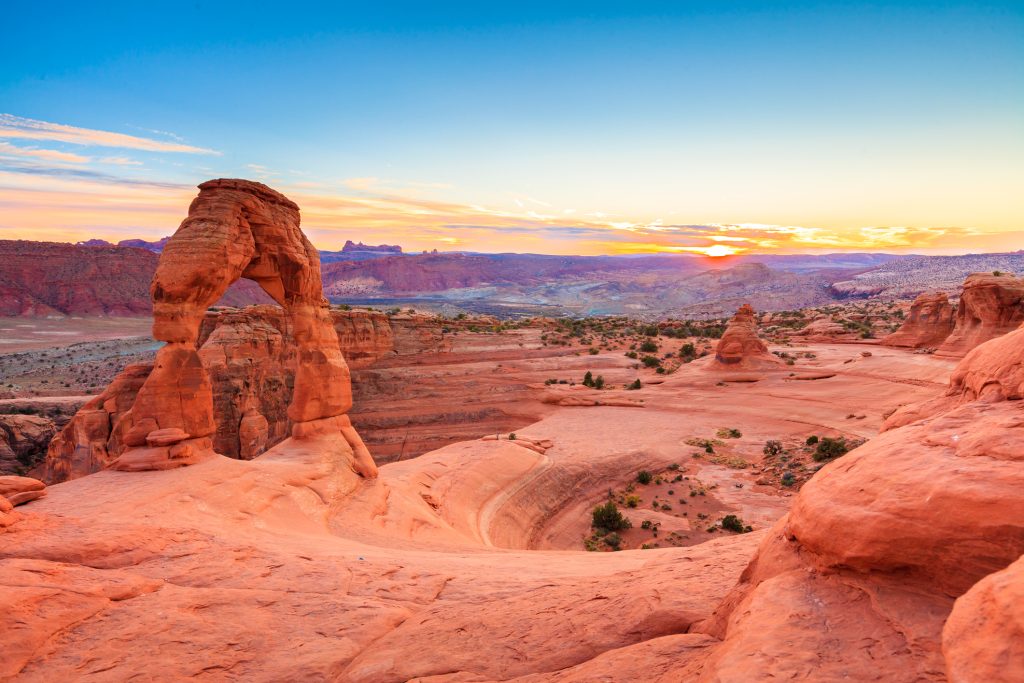
Delicate Arch, Arches National Park

Utah really has something to offer every type of geologist, which is key to the geo-seduction and continued allure of the region. If you want to walk up a relay ramp, examine a salt wall, map a series of deformation bands or dissect the sedimentology of a Jurassic dune field, then southeast Utah has it all.

If you’d like to be seduced by the geology of Utah, why not join us:

Structural Styles and Fault Characterization in Exploration and Production, Moab, Utah with Russell Davies, 6-12 Oct.

Women in Energy Field Experience: The role of Salt in Hydrocarbon Exploration, Energy Storage and Carbon-Reduction Mechanisms, Paradox Basin, Utah and Colorado with Kate Giles and Cindy Yielding, 30 Sept-4 Oct.

Meet the Expert: 5 Minutes with Jonathan Evans

We sat down with Jonathan Evans ahead of his upcoming GeoLogica course – Geology for Non-geologists

What is your field and specialization?

I’m a geologist and I worked thirty years with BP, mostly at the front end of exploration and new access (getting access to new countries). I spent part of my career with BP working in a place called Wytch Farm, which is an oil field under Poole Harbour in Dorset, southern England. While I was there, I got to know the geology of the Jurassic Coast, which is the section that runs from Exeter to Poole and is a walk through time from the Triassic and Jurassic up into the Cretaceous. It’s a particular interest of mine now and so I lead field courses along the Jurassic Coast.  

Can you tell us a bit about your career and how you got into teaching?  

As I said, I spent thirty years with BP and the first ten years were in technical geoscience roles and the last twenty were in leadership roles around the world. When I was at Wytch Farm, Dorset, a lot of BP’s introductory courses were run around Wytch Farm because you could visit an oil field and also nearby outcrops of the rocks which make up the oil reservoirs in the field. That’s when I first started teaching. I taught graduate induction courses and an introduction to reservoir geology based on the rocks of the Jurassic Coast. Having started in about the late nineties, I continued to teach right through my career, even when I was in fairly senior management roles, because it is something I really enjoy doing. 

Before BP, while I was a PhD student at Reading University, we used to host the Open University Summer School for the Science Foundation Course. The first thing that those students used to do was a field trip to a sandpit near Bracknell in southern England. That was my introduction to teaching a wide range of people who had completely different backgrounds – and no background in geoscience at all. That was a really enjoyable experience – they asked some of the best questions I’ve ever been asked. I particularly enjoy teaching people who don’t have a background in geoscience how to look at the world in a different way. 

Could you tell us a little bit about some of the favorite projects you’ve worked on?

Two highlights for me – one was with BP in Oman, which is home to a big gas project and now one of BP’s biggest producing fields. Oman is a great country to be based in – lovely people and it was an amazing project – a real career highlight. The other was Wytch Farm, which was a bit detached from the rest of BP and like a business in its own right. It was like working for a small local company and we got to do some things there that would have been difficult to do elsewhere – we drilled the world’s longest horizontal wells and BP’s first ever multilateral wells. It was a great team to be in and I had a huge amount of responsibility looking after two active drilling rigs and doing most of the geology work for a major producing oil field at that time. 

Tell us about your upcoming course with GeoLogica – what is it about and who is it for?

Geology for Non-geologists assumes that participants have no background in geoscience at all. It starts from the beginning – what different sorts of rocks there are, how you can tell which rocks are which, and the importance of them economically. I talk about geology in terms of the oil and gas industry but also about clean energy, geothermal and carbon capture and storage, and other forms of energy where geoscience is going to be important for the energy transition. The course assumes no knowledge and takes participants through to an appreciation of the different types of rocks, why they’re important, how you can understand them, and what sort of data you might acquire from them. It’s a great course for people who work alongside geoscientists and want to understand more about some of the uncertainties in the output that comes from them. Within the oil and gas industry, this course will typically be taken by people in roles ranging from personal assistants and admin staff, through to reservoir engineers, commercial analysts and even lawyers who want to understand a bit more about what their geoscience contacts are talking about. 

Jonathan Evans

Tell us a fun fact about yourself that people might not know.    

In my spare time there are two things I particularly enjoy doing – one is growing vegetables (I have a large vegetable garden), and the other one is something I took up just a few years ago – beekeeping! I have a few active beehives and produce quite a lot of honey. That’s something which has become quite a strong interest of mine over the last few years. 

What is the biggest challenge facing the sector today from your perspective? 

I think the biggest challenge facing the oil and gas sector is the public perception of the industry. We need to tell a positive story about the role of energy in society. We need not to be embarrassed about what we do. It’s important to acknowledge that we believe in climate change and we understand that fossil fuels have been a really important contributor to the climate change we’re seeing today, but also that we, as an industry and as geoscientists, can be and want to be part of the solution to that.  There is a lack of understanding that even in the most optimistic scenarios for how we keep the earth increase in temperature down to below 2°C, oil and gas will still be required as part of the energy mix beyond 2030 to 2050. And in some ways, we need more geoscience, not less, as we move forward. As fields become older, they become more complicated and you need to know more geoscience if you want to understand how reservoirs can store carbon dioxide or other fluids. You need to have a really good subsurface understanding to do that. There will still be some really interesting opportunities for the generation of geologists joining us today, and we need to be better at telling our story about what the energy industry does. You know energy fuels human progress and that’s generally a good thing and it lifts people out of poverty, allowing them to develop their economies. That is what the oil and gas industry has done in the recent past and I think that’s what clean energies of the future will do. We are in a transition phase – and it is a transition; it’s not going to happen overnight. Previous transitions have taken hundreds of years. This one hopefully will take less time, but it’ll still be decades. It’s going to need massive investment. It’s going to need massive projects to do things we need to do to reduce most of the carbon dioxide in the atmosphere and our industry presents one of the only options about who’s going to do that and pay for it. 

What would be your advice to junior geoscientists starting their careers?

Well, I guess a couple of bits of advice. One would be, don’t worry too much about the future of the industry because the world is going to need energy for many, many years to come and fossil fuels will be a part of that mix. I think gas will be increasingly important but also how we deal with taking carbon out of the atmosphere, things like carbon capture and storage. Geothermal energy will also be important and require geoscience input. 

A second piece of advice would be, when presented with some options, choose the one which keeps the most options open rather than closing things down. Don’t be scared to do things that appear challenging because that’s when you learn the most. But also, given the choice between doing something safe and that you know how to do, and doing something different that will stretch you and create new and different opportunities for you, choose the one that creates the most options rather than closing options down. 

Tell us your best/worst geology joke. 

How about a couple of puns? 

Geologists don’t wrinkle, they show lineation.  

Never expect perfection from a geologist. They all have their faults. 


Meet the Expert: 5 Minutes with Matthew Healey

We sat down with Matthew Healey ahead of his upcoming GeoLogica course – Lessons Learned from Carbon Capture and Storage Projects to Date 

What is your field and specialization?

I’m the managing director of Pace CCS. We are a multi-disciplinary engineering design consultancy that specializes in designing CCS projects. So, I live and breathe CCS all day, every day.

Can you tell us a bit about your career journey?

Yeah, sure. So, I’ve got a chemical engineering degree and I’m from Australia. I’ve worked mostly in Australia and the UK, with a little bit in other parts of the world, mainly in the oil and gas industry. That experience is relevant to CCS. I had my first big job on a project called White Rose about 10 years ago and started Pace CCS in 2017. In 2020, we made the strategic decision to focus entirely on CCS and, since then, it’s been a company that designs CCS projects. The industry emerged as a key player in the fight against climate change. We’ve worked on a little over 100 projects around the world. It’s an incredibly exciting industry to be involved in, and to be right at the start of it and involved on a global scale is an opportunity I never thought I’d have in my career. And it’s really good fun.

In terms of training, there’s a lot of demand for sharing knowledge between projects. We recognized this early on, so we’ve been running training courses as one of the things that we deliver. There are four of us at Pace who deliver training courses and, between us, we’ve delivered 25 or so public and private courses to clients around the world.

Could you tell us a bit about some of your favorite projects, or perhaps the part of the job that you have found particularly inspiring?

I think the best part of the job is being involved in so many projects. Essentially, there are lots and lots of companies developing CCS projects; some of them are energy companies looking to change their business to reduce or stop emitting CO2 into the atmosphere; some of them are in industry and are looking to decarbonize; some of them are specialist CCS developers; and then some are people who are coming into the space from the green energy perspective. But most of them are delivering their first CCS projects. Our great advantage is that we have the experience of working on many different projects around the world and that’s the reason we are so busy as a company. Taking our experience from project to project is where we can provide a lot of value.

Our first major enterprise has been the HyNet project in the Liverpool Bay area in the UK. This is a project that is based in a very, very old industrial area along the Mersey. The plan is to take the CO2 from multiple existing industries, as well as bringing new industries to the area, including a new hydrogen plant, and store it underground. The project will be reusing existing pipelines and old oil and gas infrastructure. In Liverpool you can actually stand on the jetty and look out over the bay and you can see the oil platforms on a clear day. It doesn’t happen very often (by which I mean, a clear day in Liverpool!) but when it does, you can see them. Being able to take those pipelines, those wells, those platforms, which have been there for about 40 years and which have reached the end of their life when it comes to generating oil and gas, and to take the space they’ve left behind a few kilometers below the surface of the Earth, and fill it with hundreds of millions of tonnes of CO2 over the coming years . . . To be involved with a project like that is fantastic. It’s now getting to the point where they’re going to start pouring concrete and digging holes and actually building the thing what we’ve helped design and that is really exciting. There are a lot of projects like HyNet out there nowadays, but it’ll be one of the first and it’ll certainly be one of the best based on our experiences with it. That is a really satisfying thing to be a part of, from a professional point of view. That’s a clear and obvious highlight. We’re having a lot of fun, in general, working with various projects but HyNet’s a really good example of our first major project.

Combatting climate change is obviously a very big deal for you, then?

It is. Not only was last year the hottest year on record, 2024 is on track to be hotter again. In 2023, we put more CO2 into the atmosphere than we have ever done in any preceding year. There has been a lot of work, in terms of transitioning away from carbon-intensive energy towards green energy, over the last few decades, but we haven’t even reduced the rate at which CO2 is going up in the atmosphere. The amount of CO2 in the atmosphere produced since the Industrial Revolution has gone up by fifty per cent, and it is going up now at the fastest rate than it ever has. We’ve got an awfully long way to go. If the UK is going to get to net zero by 2050 and the world is going to keep climate change to below about two degrees, which is still pretty disastrous, a huge amount needs to happen.

There are two key parts to this; one is green energy, and this means moving away from hydrocarbons, especially coal, and replacing them with wind, solar and hydroelectric; the other is CCS, which is where we capture carbon to stop it going into the atmosphere and we put it into geological storage, where we can prove it will stay. Both of those are required at the same time. There are some parts of the world where green energy makes sense. There are some parts of the world where CCS makes more sense. But in the UK, it’s a mixture of the two. Right now, we are capturing and disposing of about 10 million tonnes per year of CO2. Most of that is pilot projects. By 2050, the IPCC says that we need to be disposing of 8800 million tonnes per year. So that’s what’s required from this brand-new industry.

There is one project operating at the moment called the Gorgon Project. We talk about this during the training course, but it’s a project which has had some real problems. We can’t afford the 2000 or so projects that need to be in operation in the coming decades to have the same sorts of issues. We have to learn from these problems.

Tell us about your upcoming course with GeoLogica – what is it about and who is it for?

It’s a one-day course for people who are designing CCS projects and for their managers. It’s for the people who are responsible for the money that is being spent on CCS, and will help make those projects a success. The focus of the course is on sharing lessons learned from CCS projects around the world. We’ve got a dozen or so different projects that we’re drawing lessons from, and we’ve framed that into a course to provide useful, actionable information for people who are learning about CCS and people who are running projects. This information is a combination of details that are in the public domain and also learnings from other private projects, which we’re able to share without infringing confidentiality. So, we’ll be covering a lot of ground. We’re looking at real world issues and the solutions to those issues, and it will really benefit anyone involved in CCS design.

Tell us a fun fact about yourself that most people don’t know.

Well, I’m a former professional cricketer. I played for the West Australian Second XI and the Middlesex Second XI and that’s what I did for most of my twenties. I used to travel between Australia and England playing summers in each one. If you look at my CV, what it says I did earlier in my career is largely a lie! I was playing cricket for most of that time, not doing engineering.

GL: Bowler or batsman?

Fast bowler. I’ve described myself as Glenn McGrath, but without the height, pace or accuracy.

What is the biggest challenge facing the sector today, from your perspective?

The answer is the same for the UK as it is for the rest of the world: operations. Of the CCS projects that are out there, almost all of them are in design. Essentially, none of them have started up. When we talk about a CCS industrial hub, like HyNet, Northern Lights or like most high-profile CCS projects where we’re taking CO2 from multiple sources and using shared transportation and disposal infrastructure, they’re being combined into pipelines, going into compressors and then being disposed of in a reservoir. None of these projects are operating. Anyone who’s worked in engineering for as long as I have will know that design is one thing and operations is another. Those of us coming from energy or oil and gas, or any other industry, are used to working in a place where your operations team is incredibly experienced. They come in and they’ve seen it all before, they’ve done it all before and they know how to work with their equipment. What we have with CCS, though, is every operator is going to be on their first day, so they need to be supported by the people who are designing the systems to make them as simple and as operable as possible. One of the key lessons that will come out of the training course is to do with the challenges that projects have already seen from an operability point of view and they are significant. We’ve had projects that have had failures, we’ve had projects that have had significant delays, we’ve had projects that have had to spend money unexpectedly because of early operational challenges. So that is the major hurdle coming our way because everyone’s doing their first CCS project. People haven’t designed these things before. You’ve got companies like Pace who have worked on, you know, over 100 projects, and that’s a lot of experience, but there is no equivalent for people who have operated CCS projects. That’s the big challenge.

What would be your advice to anyone entering the CCS industry?

Wood Mackenzie published a report a couple of years ago looking at the CCS industry. They came up with very similar numbers to the IPCC, in terms of the need for CCS, and that was about 8000 or so million tonnes per year of CCS by 2050 – about 180 million tonnes just in the UK – which is a huge scale up for an industry which is at the very, very early stages. So, what I say to engineers is that if you’re a junior engineer coming into the CCS industry and you’re starting on 10 July 2024, which is when my course is running, you are going to be one of the old legends of the industry. You’re going to be the first generation of experienced CCS engineers later on in your career. And that means that it’s an absolutely fantastic place to be working. There are people who have been there, seen it all before, done it all before, but this is an industry that needs smart and creative people to solve new problems. So, it’s an ideal industry for an engineer who’s just starting out, because they’ll get opportunities they simply won’t see elsewhere.

Any general advice for working in the industry?

Communication. It’s really easy to find engineers who can do engineering. What we need is engineers who are good communicators and engineers who are creative. We don’t need engineers who can, you know, turn the handle and deliver good, reliable work. We need engineers who can tackle new problems and then communicate the solutions to those problems so they can be understood by people who aren’t experts. It is not an industry where it’s useful to be writing 150-page technical reports that can only be understood by someone who’s got a specialty in the same area. We need things to be understood by a broad range of people. So, engineers who can think creatively, who are strong at communicating – in person, well as in writing – are the people we need. The only way that we can share information and make sure that this industry is the success that it needs to be is by communicating what we’ve learned to other people. It’s no good holding information in our heads and not telling anyone – we need to share it. And that means that we need skillful communicators.

Final question. Can you give us your best engineering joke?

There are no engineering jokes.

GL: Brilliant

Matthew Healey at his desk

Fieldwork for CCS – Fluvio-aeolian Outcrops in the UK

The requirement for Carbon Capture and Storage (CCS) remains as strong as ever, driven partly by the historical and continued use of fossil fuels as we move through the energy transition. Global progress in the deployment of CCS projects has been slow but is now accelerating and the UK continues to be at the forefront of this, with large-scale planned projects, such as the HyNet hub in NW England and the Teeside hub in NE England.

The injection of carbon dioxide (CO2) into subsurface rocks is not a new technique and has been adopted for more than 50 years, specifically in the process of CO2enhanced oil recovery, where CO2 is used to displace the oil with the CO2 remaining in the reservoir rock. The injection of CO2 into the saline aquifer above the Sleipner reservoir in the Norwegian sector of the North Sea has been underway since 1994. This is specifically done as a climate change mitigation tool and remains one of the bestcase studies we have of long-term CO2 injection as part of a designated CCS project.

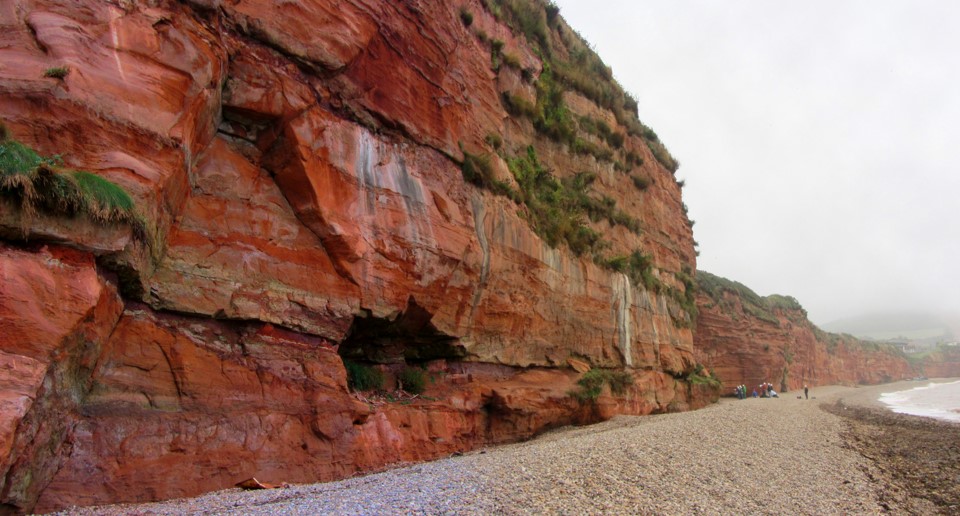
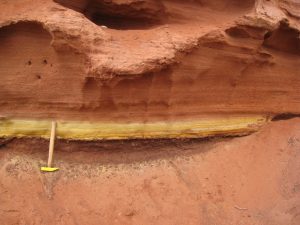
Fluvio aeolian deposits of the Triassic Sherwood Sandstone Group at Budleigh Salterton Devon
Fluvio-aeolian deposits of the Triassic Sherwood Sandstone Group at Budleigh Salterton, Devon.

It is now known that we can store carbon dioxide in a variety of underground geological formations, including non-producing oil and gas reservoir rocks, saline aquifer rocks, layers of volcanic basalt and even coal beds. In the UK, both saline aquifer rocks (e.g. Bunter Sandstones in the Endurance storage site) and old hydrocarbon reservoir rocks (e.g. the Ormskirk Formation of the Hamilton field) are planned as CO2 storage sites. Sites that once held hydrocarbons have large amounts of data available to geologists and reservoir engineers to scrutinize when ascertaining, for example, the rock and reservoir properties (e.g. porosity and permeability) and potential seal risks for a planned CO2 injection project. The key factor is undoubtedly permeability of the reservoir rocks, as it will control injection rate and therefore how many wells are needed for CO2 injection and ultimately project costs.

Permian and Triassic sandstones in old oil and gas reservoirs are some of the main CO2 storage opportunities in the UK offshore. Leman, Bunter and Ormskirk sandstones preserve a variety of facies types, including aeolian sediments representing deposits laid down by the action of wind-blown sand in arid continental settings. Fluvial (river) and lacustrine (lake) deposits are also present in these formations, and understanding the subsurface arrangement and properties of these deposits is clearly of great importance for CO2 reservoir storage characterization.

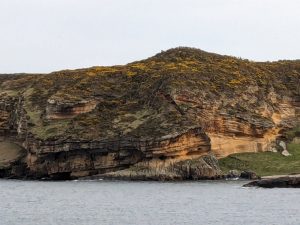
Aeolian deposits in the Permian Hopeman Sandstone Hopeman
Aeolian deposits in the Permian, Hopeman Sandstone, Hopeman.

The value of observing and examining these rocks at outcrop in order to understand aspects such as rock properties, heterogeneity and connectivity etc., coupled with wider reservoir characterization themes for CO2 storage, cannot be underestimated. At GeoLogica, our portfolio of CCS courses continues to grow and is supported by a range of multi-disciplinary options that compliment these (e.g. clastic depositional systems, reservoir modelling for CO2 storage and re-purposing infrastructure).

We would like to highlight the value of field training and have three field courses available for in-house groups to explore CCS reservoir storage:

E550: Carbon Capture – Reservoir Storage and Risk Elements: Insights from the Field, NE England

Focus is placed on the assessment of reservoirs that have the potential for carbon storage in the subsurface with an emphasis on suitable prospects.

E556: Reservoir Characterization for Carbon Capture and Underground Storage, Devon and Dorset, UK

A field-based overview of CCS with a focus on widely exploited depositional environments and their associated heterogeneity.

E578: CCS Reservoir Geology at Outcrop: Rotliegend and Bunter/Sherwood Sandstones, Cumbria and NW Cheshire

A course that gives subsurface teams the opportunity to see at outcrop some of the rocks they are planning to use as CO2 storage sites in the UK.

The value of fieldwork cannot be underestimated, so for more information on these and our scheduled CCS courses, please visit our website or get in touch with us: info@geologicaworld.com

Meet the Expert: 5 Minutes with Malcolm Ross

We sat down with Malcolm Ross ahead of his upcoming GeoLogica course  Transition Skills: From Oil and Gas to Geothermal (E573)

What is your field and specialization? 

I am a geologist by training, with a bachelor’s, master’s and PhD, and I’ve worked a lot in the geothermal area. My master’s degree was in plate tectonic modeling, and paleogeographic and paleoclimate modeling, and when I worked for Shell, that’s what they hired me to do. But I wanted to get into the innovation side at Shell and so I joined a team called Gamechanger, which is an angel investing entity within Shell. That got me into the innovation space. From there, I wanted to move into geothermal energy because I thought it would be a way to have a positive impact on the energy transition while using my geological skills.  

Tell us a bit about your journey into teaching.

When I finished my master’s, it was a downtime in the oil and gas industry, so I said to myself, ‘OK, I’ll go get my PhD.’ But by the time I finished my PhD, the oil industry had gone through a full boom-bust cycle, which is fairly typical, and it was another downtime. I always thought I would be a professor, but many university departments weren’t hiring. So, I started my own company and did a bunch of my own work. But I had always wanted to teach – I wanted to pay it forward. So, I persuaded Rice University to let me teach there as an adjunct professor; I didn’t receive pay because it would have been a conflict of interest with my other jobs. Plus, it would have just made for more tax paperwork. I asked them to take what would have been my minimal salary and use it to pay a graduate student to help me as a TA. I did that for over a decade. It has been really rewarding to hear either through LinkedIn or back channels that a student has transitioned their career based on my teaching. Just the other day, a student told me he was in my class because another student had told them it was the best course they had taken. That student said it was the most useful course they ever had at Rice, and it had nothing to do with what they were studying, but now they use GIS every day. That’s very rewarding.  

When I got into the geothermal space, I wanted to help university students who felt a little trapped in their oil and gas career path. This generation’s inner psyche is much more sustainability- or green-oriented, and they feel guilty about getting into oil and gas. They’re looking for a way to apply their skills – just as I saw an opportunity to use those skills in geothermal. I didn’t even know that geothermal existed when I was at university; I didn’t even know there was an opportunity there. I am trying to make as many of them aware of the opportunity as I can. 

Tell us about a favourite memory from fieldwork or field training? 

I have a couple, but let’s go with the one with my PhD advisor, a guy named Peter Vail, who is quite a famous stratigrapher. During my PhD, my advisor suffered a major brain trauma and nearly died; it was touch and go for quite a while. He returned to Houston, received a lot of physical therapy, and recovered to the point where he could go back to teaching. He was fully paralyzed on one side of his body. When he got back to teaching, he needed someone to help him because he really had no way of retaining short-term memory. If students asked a long-winded question, by the end, he would lose track of what they said at the beginning of the question. His long-term memory was perfect – better than mine – but it’s one of those brain trauma things where you never know how the brain is going to respond. Anyway, my favorite memory from fieldwork is that we arranged for him to go out in the field in this state where he was pretty disabled. We organized a field trip to the Guadalupe Mountains out in west Texas, which was sort of his home turf, his favorite fieldwork area, and a great place to take people to see sequence stratigraphy. We had a group of students and some scientists from an oil and gas company, and we were able to visit roadside outcrop. The bus would pull up to an outcrop right on the side of the road and he would use his cane to indicate the different rocks and what was visible in the outcrop. The joy that he felt being able to get back out there when he had mentally written that off as just not possible! So, my favorite memory of going out in the field is not anything to do with the rocks. But the personal connection and the joy of seeing someone who’s suffered trauma and never thought they’d get to do something again when they get to do it. The joy and the excitement that they felt in the field was special for me. I continue to see him – he is in his nineties now and still functioning, although still paralyzed on one side of his body. I’m having lunch with him after this interview! 

Tell us about your upcoming course with GeoLogica – what is it about, and who is it for? 

The course is about the fundamentals of geothermal energy. The point is to take people quickly through my journey from being an oil and gas expert to becoming a geothermal expert. What are the fundamental skills needed? What transferable skills do you have? What skills need to be slightly refocused to do geothermal? The target audience is people in the oil and gas world who want to make that transition. Some of them might be coming straight out of school, and some of them might have 20–30 years of experience. However, all of them will be looking for an understanding of the opportunities and how their skills might fit. That’s the point of what I’m doing. 

Tell us a fun fact about yourself that most people don’t know.   

You can probably tell that I’m kind of comfortable in front of the camera. And the reason is that, as an undergraduate, I did a double degree in geology and theatre! So, I’m actually a teacher with acting training. I had to choose whether I would go do my master’s in geology or fine arts and theatre. I struggled with that decision for a long time. Eventually, I picked geology because I thought there’d be more jobs available. There are a lot of unemployed actors out there, right? Remember that old joke: How do you get the attention of a good actor?  ‘Waiter! Waiter!’ Well, in Houston, both when I graduated with my master’s and when I graduated with my PhD, the running joke was: How do you get the attention of a good geologist? ‘Waiter! Waiter!’ So, I was not sure I made the right decision! But I think the teaching I do is a form of theater. It’s improvisation. It’s technical improv, but it’s still improv. And that’s what I specialized in when I was an undergraduate – improv, stand-up comedy, and Shakespeare as well. But I won’t do this interview using the iambic pentameter! The acting comes through in answering students, responding to students, and energizing students – it is a form of theater.  

I actually continued acting during my master’s degree work; I did some outside theater work and performed in Houston while I was doing an internship there. It was a show that was going on the road to Broadway and they asked me to quit school and join the cast. Again, I struggled, but eventually, I said no. I wanted to finish what I had started. I went back to my master’s thesis. When the show went on to the next town, Indianapolis, it collapsed, so I was glad I’d made the right decision that time! But, anyway, the fun fact is that I could have been on Broadway. I could have been a contender! 

What is the biggest challenge facing the sector today from your perspective? 

The biggest challenge in the geothermal sector is scaling – geothermal currently provides just 0.4% of the energy into the grid, which is essentially nothing globally. That’s a little bit unfair because geothermal energy actually has two parts – one is making electricity, but the other is the direct use of geothermal heat for heating homes and doing industrial work, etcetera, and they never talk about that. That’s really the better way to use geothermal energy because it uses 100% of the energy; while converting it to electricity, you normally get less than 15% efficiency. You waste 80% or more of the energy in the conversion. If geothermal is going to have an impact, though, it’s going to have to scale up and that means going to different parts of the world, rather than just the spots where you see boiling water coming out of the ground, like in Hawaii, Iceland and California, and around the Ring of Fire. You have to be able to go everywhere. That’s really been a focus of what I’ve been doing, trying to figure out how to make geothermal work everywhere and then, if it’s successful, how to grow it. For example, one of the companies I work with is called Eavor. They’re a closed-loop geothermal company. They have a project near Munich, Germany, that will start producing power in the third quarter of this year, to power and heat a town outside Munich. If it works, they have dozens of new projects lined up who have said they’ll sign on the dotted line. If they are successful, the challenge will not be ‘Can Eavor do this’, but rather, ‘How are we going to service dozens of customers at the same time’, especially when it takes a year to drill each well for each customer and there’s not enough land rigs in Europe to do that. 

The challenges are growth-related challenges at first. Then, once we can show it’ll work, it’s how to make it widespread. The only way to do it is to transfer human resources from some of the oil and gas work to geothermal energy. You’re not going to build it from scratch. It’s going to take too long.  

So, that’s why I’m doing this class. I’m feeding the beast. We’re trying to get it to grow. It’s a growth-related challenge; it’s not a dying industry. It’s a ‘Where am I going to find my next job?’ kind of problem. 

What would be your advice to junior geoscientists starting their careers today? 

I’ll tell you something – and this advice may not be so much for juniors but actually for some of the people who might be coming to this class and transitioning their career from one area to another, and that is this – I mentioned that I worked for Shell in their Gamechanger team, angel investing, taking ideas from the back of a cocktail napkin and turning them into something investable – that was the target. So, I had a business card that said my title was ‘Gamechanger’, and I would hand that business card out and people would say: ‘Gamechanger, that’s a cool title – what do you do?’ And that’s what a business card should do. It should start a conversation and be memorable. And people would come back, years later, and say, ‘Oh, you’re the guy who had Gamechanger on your card, right?’ Titles matter, and if your title says Geophysicist or VP for Marketing, or something like that, it’s not as memorable. So, when I took my last job at Shell, they allowed me to create my own job and my own title. The title I selected was based on the fact that I needed to encourage people to ask me to tell my story. So, I gave myself the title ‘Black Swan Detector’. That had levels to it. So, Black Swan is an event. For example, COVID was a Black Swan. No one expected it. It was huge. But once it happened, people said, ‘Oh, it was obvious that it would happen sometime.’ And that is what defines a Black Swan event – large, unexpected and, in hindsight, predictable. I was looking for Black Swan ideas that Shell could invest in – ideas that no one thought would work but eventually were shown to work and then, all of a sudden, it was a big deal. That’s what I think closed-loop geothermal is – a Black Swan idea – it’s unproven, unexpected and could be an enormous opportunity if we can apply it everywhere. By the way, I also chose that title because I liked the acronym ‘BS detector’ – that described a lot of what the job was. It is, as you may know, about being able to realize when it’s never going to work; it doesn’t obey the laws of physics, so forget it. I had to use a bit of a BS filter.  

Now, my title is Geothermal Evangelist, and that’s what my business card says. And again, it is the same thing, people ask: ‘What’s a Geothermal Evangelist?’ So, my advice, and this is kind of a little weird kind of thing, but it works, is pick a title that will cause people to ask what you do.  

Recently, after hearing about my title, a couple of guys I was presenting to were whispering in the back row, and eventually, they introduced themselves – one was a Chief Marketing Officer and the other was the Chief Financial Officer of a startup. They went on to ask their CEO if they could change their titles, and he said, ‘Sure!’ So now, if you meet these two guys and see their business cards, the Chief Marketing Officer card now says, ‘Chief Storyteller’, and the other guy, who was the CFO, took the title ‘Chief Truth Teller’. And so, they go out and hand out their business cards together, and it is memorable, right? And that’s the key. That’s the key element. It’s kind of a strange piece of advice, but get a title that makes people want to know more about you. 

Give us your best/worst geology joke? 

Depending on how you interpret best . . . I’ll even make it a geothermal joke. How about that? 

What do wind turbines think about geothermal energy? 

They’re big fans. 

Meet the Expert: 5 Minutes with Richard Worden

We sat down with Richard Worden ahead of his upcoming GeoLogica course: Carbon Capture and Storage Masterclass (E502)

What is your field and specialization?

That’s an interesting question and not that simple to answer, actually. My field is broadly the area of sedimentary geology and within that my specializations are quite wide-ranging, including geochemistry, sedimentology itself, petrophysics, even moving into geomechanics. In terms of area of application, of course carbon capture and storage is my focus, but these days I have also applied it to hydrogen storage and, though this might seem like a stretch to some people, nuclear waste disposal in low-strength sedimentary rocks. That was working with Nuclear Waste Services, which is an arm of the UK government. We are working together to develop a repository for the UK’s medium- and high-level nuclear waste deep underground, away from any possible exposure for thousands to millions of years – so an incredibly long timescale.

Tell us a bit about your teaching journey

OK, I’ll take it right back to the beginning. The first teaching I ever did was as a postgraduate demonstrator to undergraduates when I was a PhD student at the University of Manchester. I enjoyed it, but I soon realized at the tender age of 22 that dealing with 18-year-old undergraduates can be quite a challenge! They’re a surly, unresponsive bunch at times – you have to work hard to explain things to them and you need different ways to explain them.

The next thing I did was teach on a course called Reservoir Quality Prediction for BP. I worked for BP from 1989 to the mid 1990s and the team I was part of delivered the course to different teams around the world. One of the most memorable occasions was when I ran the course in Yemen, of all places, in 1991 or 1992. It was quite an interesting place to go in those days – a sort of Wild West!

I left BP and briefly became a temporary lecturer on a three-year contract at Durham, but I was almost immediately offered a permanent job at Queen’s University Belfast. The peace process was in full swing and it was a lovely place to be. So, I was a lecturer in geology at Queens Belfast for five years, then I left there and came to Liverpool in 2000, which is where I’ve been teaching ever since. I’ve been giving professional training courses since 2006. The very first one I gave was to a company called CEPSA in Madrid, Spain, and it was a course called Reservoir Quality Prediction. No surprise that it was a similar area to what I taught for BP. Technical content was vastly different 10 years later, though. I’ve been teaching carbon capture and storage as a master class and offering courses in geochemistry of carbon capture and storage. I’ve been doing that for 2 1/2 years or so and I’ve given the course many times – 37 times, in fact, to more than 600 people.

What is your favourite memory from fieldwork or field training?

I’m going to give two because the first was as a participant. I didn’t really like the way I was taught field geology as an undergraduate, and it was only when I joined BP and received their tailor-made field training that I really enjoyed it. Although, just to back up a little bit here – the field training I received as an undergraduate seemed a bit ad hoc, but the mapping dissertation I did, which was in glorious Snowdonia in North Wales during the weirdly hot summer of 1983, was a baptism of fire. I loved it. Absolutely. When I started to do my undergraduate mapping I was not a geologist but I finished it as a geologist. I fully understood by the end what it was all about.

And then I joined BP and I went on a number of field classes. The most memorable was a two-week field class called Sedimentology 1. We travelled from roughly the Chesterfield/Sheffield region all the way up to Berwick upon Tweed, stopping at four different locations over two weeks. In the mornings, we did a bit of classroom work – (there was a flatbed lorry following us along the route taking core, believe it or not) – and then we’d look at rocks in-situ as well. The rocks gave us 3-D, the core gave us 1-D and the theory filled in the gaps. I thought it was the most amazing field experience I’d ever had. It really brought everything together. It has informed the way I’ve done field teaching ever since.

I used to run a field class on the south coast of England in Devon and Dorset called the Wessex Basin field class. Many, many people have given courses like that. My own evolved over the years and developed quite a unique flavor – I know people have gone on my course and then subsequent courses, and they appreciated what I delivered. But my favorite memory of field teaching, in terms of giving and designing a course, was a two-week field class on petroleum reservoir geoscience that we used to run at Liverpool for the MSC course. It covered all the way from Brora and Helmsdale up in north-east Scotland to as far as Flamborough Head. We visited reservoirs of all sorts of different ages, lithologies and depositional environments. We had wireline log equivalents for all the outcrops. The students could work on the outcrop and we’d have short lectures. Guess what we based that course on? Yep, the two-week field class from BP. The big difference was the access to core. No one would have paid for a flatbed lorry to be following us around and we just don’t have that material available at Liverpool!

Tell us about your upcoming course with GeoLogica – what is it about and who is it for?

It is a Carbon Capture and Storage Masterclass (E502) and it’s a mature course. It’s had its rough edges knocked off – not that there were that many to begin with! But as a teacher you realize some parts of a course can work better than others. And as you get little bits of feedback and comments, you realize where students need more information and sometimes where they need less. The needs of every class are different and that also requires thinking about. I have found that when I give the course to an individual company, they ask lots and lots of detailed questions, but when it’s an open course with people from many different companies and backgrounds, they are much more reticent and there is less discussion. That means there’s slightly more time available for exercises or it can feel less squeezed – fitting the material into a five-session slot is a bit of an art, to tell you the truth.

The course kicks off talking about the very reason we need to undertake carbon capture and storage – we are emitting greenhouse gases at an incredibly fast rate, much faster than nature can draw them down. And it looks like we aren’t able to stop using fossil fuels without causing a social catastrophe, so we need a way of mitigating or ameliorating the gases that are emitted. The objective is to inject them underground as much as possible and as soon as possible. On the course we deal with geophysical aspects, seismic analysis of carbon capture and storage sites, especially 4-D seismic and imaging a CO2 plume moving through a saline aquifer. We deal with log data, we deal with sedimentological data, we deal with geochemical data and geomechanical data, and aspects of all of these pertaining to carbon capture and storage. It is hugely focused on carbon capture and I dip into all and every discipline necessary to give people a holistic understanding of it.

The course is designed for people with at least some experience of the subsurface, preferably geologists or petroleum engineers. I’ve also taught people with more of a chemistry and physics background; so long as they’re mentally alert enough with enough background knowledge, they can keep up, too. (I wouldn’t recommend the five-session course to people without a technical background, though.) There are lots of exercises that provide a break from listening and discussing, and this is where the attendees can test their knowledge. What I find is that the discussion that goes on between attendees when they’re put into breakout rooms to work together is where lots of shared learning happens, because people have caught on to different aspects and they seem to almost always get to the answer, which is very pleasing.

Tell us a fun fact about yourself that most people don’t know

First and foremost, despite working for BP, despite my area of research and all the papers I’ve published, despite giving all these courses, my PhD was in hard-rock geology, metamorphic geology. It is a huge departure to go from that PhD topic to what I’ve done ever since. Most people would not even guess it. So, there’s one fact. What other facts? I go swimming at least five times a week. I swim outdoors as much as possible, including in the sea in Pembroke. Interestingly, it wasn’t that cold when I went in last week, but the waves were very high and my wife got quite nervous for me. She started waving her arms like a maniac and I thought she was saying, ‘Hello.’ She was actually saying, ‘Come back before you end up in America!’ I go to yoga sessions at least three times a week and between yoga and swimming I’m trying to keep myself hale and hearty, despite the fact that I’m not 100% at the moment. But one does one’s best. I’m also a vegetarian and have been for more than 40 years, which people are often quite surprised about because some people think vegetarians are a joyless and dour bunch of people and that is most certainly not me in any regard whatsoever! So, there we go. There’s a few facts.

Why did you change tack after doing a PhD in hard rock geology?

Well, that takes me back to the previous comment. I was slightly uncomfortable during the PhD about the lack of application to the work I was doing. There is a need for theory, there is a need for work that doesn’t immediately have an application, and you could argue my PhD was preparation for what I’m doing now, but did the work lead to or was it part of a movement that changed the world? I really struggled to say yes to that. I like waking up in the morning and thinking I am going to do something today that somewhere along the line might help someone say, ‘Yes, we can use that. Now we can make practical decisions. This will help us with our day-to-day decision making.’ That is what I love. I love that notion – making a difference. That’s what I changed.

What is the biggest challenge facing the sector today from your perspective?

Where do we begin? Continuity of government initiatives is one. The biggest risk to the world, as far as I can see, and this might be a bit political, is a change of presidency in the United States and bringing in someone who eviscerates the Inflation Reduction Act and removes the incentive for carbon capture and storage. That would have knock-on effects around the world because the United States is very much leading what’s going on at the moment, with other countries following very close on their heels. But the USA is pushing very, very hard. I think we have our own issues in the UK with continuity of government initiatives and motivating companies to engage in carbon capture and storage. There was the so-called ‘Lost Decade of CCS’ from about 2010 to maybe 2017, when there had been lots of initiatives promoting companies to advance CCS and then the UK government removed the incentives and lots of projects withered on the vine. Some may never come back or have only lately started to come back. If we’d done these things 10 years previously, the problems that we are now facing would have been a lot less.

I think public acceptance of carbon capture and storage cannot be assumed. We saw what happened with fracking. I think it was right that fracking was objected to by the public as it would have been exactly the wrong time to develop a new fracking industry in NW England, for example, but the decision not to go ahead wasn’t driven by policy and by decision-making, it was driven by a somewhat hysterical public reaction. We must make sure the same thing doesn’t happen with carbon capture and storage.We need to get out there and talk to as many people as we humanly can about what is going to happen and what the risks are. And we should be realistic with people, rather than hiding the facts from them. We also need to talk about how good carbon capture and storage needs to be in order to be effective. It isn’t just good enough to put ‘quite a lot’ of CO2 underground. We need to put the vast majority that we are producing underground. There are other problems as well. For CCS to work, we need to get away from using point sources of burning fossil fuels. I’ve got the central heating on at home because it’s very cold, but we can’t capture that carbon dioxide. If the house was heated one way or another through electricity from a central power station, then we would be in a much, much better position to capture that centrally generated CO2 and dispose of it. And that’s the drive behind heat pumps and so on, because they will be driven by electricity. What we need to do is insulate houses effectively to make the heat pumps vital. We need to move to electric cars and electric vehicles in general. I think that is a major problem and the government is not dealing with it at all in terms of costs, feasibility, supply of electricity to houses to charge up cars and so on.

What would be your advice to junior geoscientists starting their careers today?

Interesting question . . . Persevere.

Be prepared to go outside your comfort zone. Trust in the wider world. Don’t cut options off too early. Be prepared to change your career direction, as I did after my on PhD, because it can be incredibly fruitful and rewarding. My own motivation, I’ve realized increasingly as time goes on, is to make a difference. To start with, the first motivation for most people is just to keep body and soul together, earn enough money to have somewhere to live, put food on the table and stay warm. Once you’re beyond that and you are heading towards mid-career, you can think about making a difference to the world around you. I think we geoscientists are in a prime position to help with some of the world’s major problems. So, think about that and stick at it. Don’t give in too early.

Also, be prepared to move. If you are a home-bod who just wants to stay in your immediate vicinity, then you might struggle. In terms of a meaningful career, it’s important to move. Once you’re in a position of strength, you can start determining where you live, as opposed to just being buffeted by where the jobs are made available, but at the beginning of your career, you need some flexibility in terms of where you live.

Give us your best/worst geology joke

Q: What’s the definition of a geologist?

A: Someone who drinks too much and has a bad sense of time!

RW – Whoops. I wasn’t prepared for that at all!
GeoL – The cornier the better!

Find out more about Richard Worden’s upcoming course: Carbon Capture and Storage Masterclass (E502)

Seals, Containment and Risk by Richard Swarbrick

Seals are barriers to fluid flow – sometimes highly effective (such as when hydrocarbons have been trapped underground for long periods of geological time) and sometimes stopping migration for only short periods. Since evidence of leakage is commonplace, we know that many seals fail naturally allowing fluids (and gases) to escape elsewhere in the associated rock sequence or to the surface. This has been identified from both natural surface seeps and changes in remote data quality, such as on seismic records in the subsurface.  The new challenges of containing unwanted CO2 from the atmosphere and/or directly from industrial processes, as well as nuclear waste, create a new imperative to understand where seals are located in the surface and how effective they will be for long-term storage. Massive investment in long-term storage is planned globally to mitigate the long-term effects of CO2 as a greenhouse gas – seal analysis is a critical component in defining the most suitable underground repositories that meet the criteria set by regulatory authorities.


[above] Multiple tensile fractures in Marcellus Shale, a brittle source rock of Devonian age, found in the Appalachian Mountains, Upstate New York. Fractures represent a seal breach risk (photograph by Richard Swarbrick).

From a geological point of view, seals can be usefully divided into membrane seals (fluid escapes due to high buoyancy pressure) and hydraulic seals (fluid escapes along new pathways of fractures and faults) – the starting point for this is a new applied training course with GeoLogica, Seals, Containment and Risk for CCS and Hydrogen Storage (E570). What are the similarities and differences in these two groups of seals? What data are needed to assess the distribution and rock properties of seals? The course will illustrate the main processes of seal formation and the data required to diagnose those rocks that could be considered as seals. It will explore the worldwide distribution of seals, largely based on detailed characterization of rock-fluid systems from borehole data, which will also be developed as case studies and exercises to reinforce learning. Since leakage is commonplace, what are the risks of leakage (seal breach) from reservoirs injected with CO2 for long-term sequestration and storage, and/or hydrogen and compressed air repeatedly stored and released for electricity generation at peak times? How do the predicted leakage rates match regulatory requirements for storage?

The course tutor, Richard Swarbrick, has been conducting professional development courses globally for over 30 years, mainly concerning the description of rocks and fluids as they relate to sealing in the subsurface. Former participants on courses have praised his teaching style, making complex issues more easily understood and reinforced with relevant exercises for participants to work through independently or in groups.

For more information on the course and to sign up please click here.

[left] Oil seepage/leakage from sandstone along the coast of California, indicative of membrane seal failure (photograph by Richard Swarbrick).
[right] Multiple tensile fractures (now filled with white cement) in Cretaceous source rock shales found in Arctic National Wildlife Refuge, North Alaska. Fractures filled with cements may be a more effective seal than the un-fractured shales (photograph by Richard Swarbrick).