World-class training for the modern energy industry

The Full Rainbow: Explore the Future Hydrogen Landscape with a new GeoLogica Training Course

Hydrogen is the simplest possible molecule yet it is set to have a prominent role within future energy scenarios, predominantly driven by its ability to store and deliver usable energy.

In the UK there are plans to develop a number of projects with hydrogen production and industrial usage, coupled with CO2 capture and storage. These will be driving the sustainable development of a future hydrogen economy.

A new GeoLogica course, Hydrogen Masterclass: Production, Geological Storage and Operational Engineering with Katriona Edlmann, will provide participants with an overview of the current hydrogen landscape, from hydrogen’s role in the energy transition, to its production, geological storage and the economic challenges it presents.

As the hydrogen economy grows, demand is likely to exceed capacity of above-ground energy storage technologies. There will be a need for the geological storage of hydrogen in a variety of locations, including depleted gas fields and mined salt caverns. Katriona’s course takes a focused look at the key considerations of these geological storage options, including their capacity, integrity and operational issues. Participants will learn to:

  1. Appreciate the role of geoscience in the hydrogen economy and the contribution hydrogen can make to the energy transition in support of net zero emission targets.

  2. Describe the different processes involved with hydrogen production and the associated lifecycle carbon intensity of this production.

  3. Recall details of the developing hydrogen supply chains, including infrastructure considerations, distribution networks and pathways for market growth.

  4. Describe the different geological storage options available and their capacity and spatial constraints.

  5. Understand hydrogen as a fluid in the subsurface, including its thermodynamic and transport properties.

  6. Characterise the geomechanical considerations for storage integrity and associated risks, including caprock sealing considerations.

  7. Appreciate the impact of geochemical and microbial interactions in subsurface hydrogen stores and the relevant monitoring and management tools.

  8. Describe the operational engineering considerations and monitoring of hydrogen storage sites.

Join the hydrogen debate and explore the role that hydrogen can play in decarbonising the energy system with GeoLogica training.

Collecting geoscience data does not de-risk projects. So why collect it? And what does risk mean?

Geoscientists need to advance their skills in predicting how an exploration prospect may fit into its mineral system and portfolio, knowing the possible value from future data acquisition programs and understanding the likelihood of them happening. This is future-facing exploration.

By Graham Banks, Route To Reserves and Southern Geoscience Consultants

There are numerous statements in exploration industry, corporate and academic literature about projects and exploration prospects being “de-risked” by additional data, analysis or analogues.

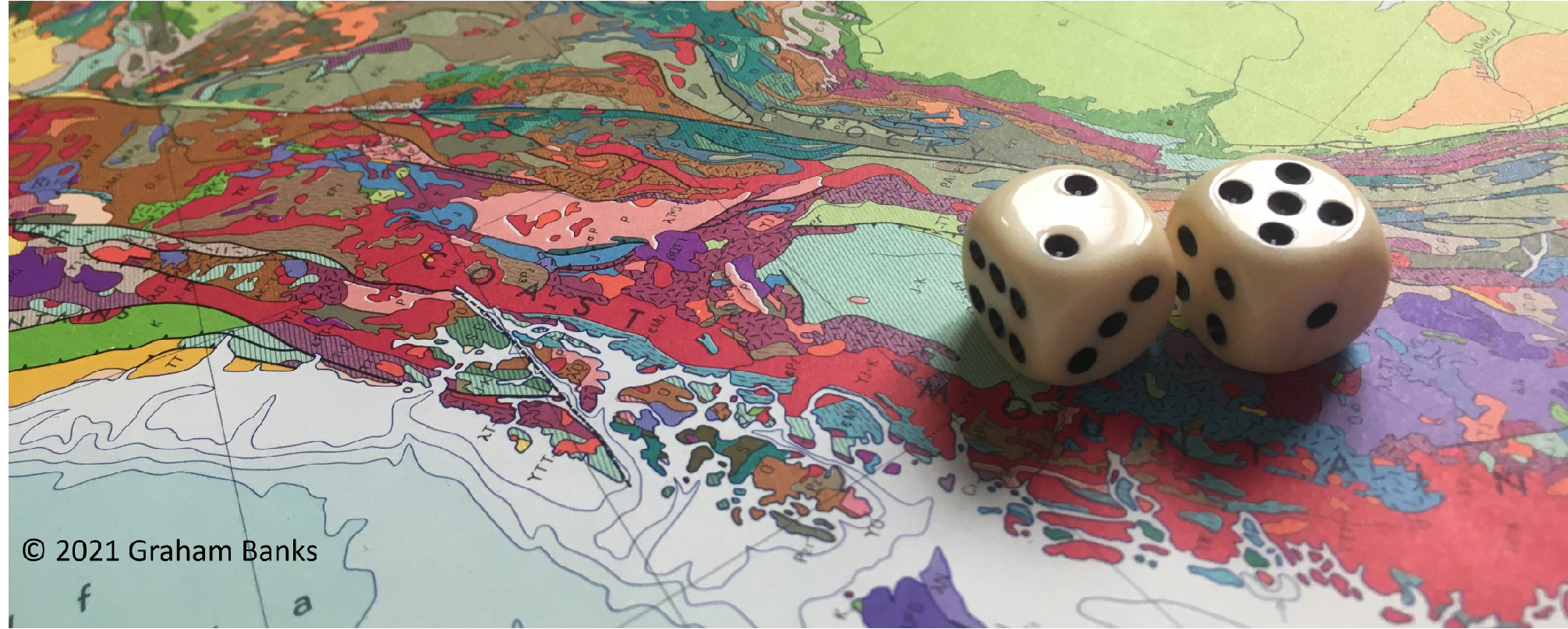
Unfortunately, this message is not correct. After gaining more information and knowledge, organisations may still proceed with unwise decisions, or continue along a course of action that erodes value for the benefactor/investor. In terms of “de-risking” a mineral prospect, additional information does not change the “risk” that the prospect could become a discovery. The dice were rolled by Nature millions to billions of years ago. The extra information serves to reaffirm or change the team’s perception about the success and failure scenarios of their prospect.

Let’s continue with the way industry uses “de-risking” for one more paragraph. One would assume that a mineral deposit would be “de-risked” after >$100 million had been spent over a decade drilling tens of kilometres of core, conducting a positive feasibility study and receiving the go-ahead to start mining. Yet we see news articles reporting how some ore reserves shrink after mining has started, despite all that data collection and modelling.

Two other common statements in exploration literature and corporate statements are that: (a) early exploration is “high risk, high reward”, and (b) progressing an exploration project reduces the risk. Statements like these may persuade investors to fund geoscience surveys and analyses, but high risk events can arise any time between early stage exploration and mining e.g.:

  • A mine event leading to injuries or fatalities.
  • Political decisions to raise mining sector taxes.
  • Economic conditions leading to commodity devaluation.

These types of erroneous statements may originate from an inaccurate understanding of “risk” amongst geoscientists. Or worse, a variety of inaccurate definitions and uses of “risk” amongst geoscientists. The implications can be severe: disagreement, reluctance to co-operate, overconfidence in a questionable prospect, hazards at the drilling rig, confused investors, wasted dollars, loss of credibility, etc.

Exploration geoscientists frequently use words like risk, value and uncertainty to promote their work and projects to management, investors, policy makers, etc. Therefore, it is crucial that geoscientists use these terms correctly and consistently. What is your definition of geological risk: a landslide; the drill bit not getting through the permafrost; not enough soil geochemistry data? Inconsistent vocabulary doesn’t help decision makers.

Few geoscientists are taught the implications of using words like risk, value, probability and uncertainty during university geoscience classes or professional development courses. Which is strange, because universities and training courses deliver standard definitions and categories for lithologies, species of fossils, sediment deposition settings, chemical formulas of minerals, etc.

So, where do geoscientists learn to use such terms accurately and appropriately? This Holistic Exploration Workflow for Critical Minerals Exploration course led by Graham Banks and Steven Fehr bridges a knowledge gap between higher education and the minerals-mining industry. Graham and Steve have spent most of their careers conducting and QCing exploration programs and business opportunities, through the lens of geoscience integrated with strategy, risk, uncertainty, probability and value of information analysis.

This professional development course guides attendees through the correct uses of risk, value, uncertainty, probability of success for critical mineral exploration and modelling. It also informs attendees about biases, the mineral system, deterministic and probabilistic approaches, accuracy versus precision, different types of value, and the value of acquiring new geoscience information.

Three other subject matter experts share their industry knowledge during the course to broaden its themes into a holistic exploration strategy:

Amit Sharma (Mining Sector Lead, Matrix Solutions Inc.) will explain the Environmental, Stakeholder and Governance considerations (ESG) required at each of regional, district and local exploration phases. Incorporating ESG into the early exploration phase is important to: raise additional capital; check the future mining operation could be feasible; practice environmental stewardship; ensure correct stakeholder engagement; understand the regulatory landscape, water resources and climate adaptation, etc.

Colm Murphy (Chief Geoscientist, Bell Geospace) will show how full tensor gravity gradiometry is adept at mapping sub-surface structure.

Robert Hearst (Consulting Geophysicist – Americas, Southern Geoscience Consultants) will summarise the use of geophysical techniques to identify mineral system ingredients.

Most mineral exploration courses and tasks are about increasing interpretation detail and precision for already-collected data. Usually in a small geographic area. Often located next to historic (i.e. not presently viable) mines. This is history-facing exploration. The big-picture consequence is that “conventional” mineral exploration and prospecting is not efficient. Only a few big discoveries are made each year, despite $ billions spent. According to Rio Tinto, the chance of a greenfield mineral target becoming a “world-class” mine is 1 in 3333. Many exploration and geoscience projects should have stopped at an early stage. In recent years, the industry generated $1 for every $2 spent. Investors are not receiving sufficient return on their investment. And now, mineral exploration needs to go deeper under sediment-vegetation cover and into under-explored regions. How can geoscientists help decision-makers better allocate budget into a deep rock volume with sparse information?

Geoscientists need to advance their skills in predicting: (a) how an exploration prospect may fit into its mineral system and portfolio, (b) the possible value from future data acquisition programs and (c) the likelihood of them happening. This is future-facing exploration: the drilling programs and results haven’t happened yet. Geoscientists need an efficient method to increase exploration chance of success, e.g., rate exploration programs and portfolios by a mineral system’s possible extent and value. Exploration expenditure may have most impact when directed at the weakest links in the team’s success case model. Graham Banks and Steven Fehr’s course teaches the foundations of that logic:

  1. Understand some of the techniques and tasks of an industry exploration geoscientist.

  2. Put a mineral exploration project into province, mineral system and play context.

  3. See mineral exploration as a high-risk game of chance, that requires a probability of success estimate and approach.

  4. Adapt best-practice exploration techniques from other commodities into the critical minerals sector.

  5. Create and efficiently communicate maps and cross sections to estimate the migration pathways and deposition locations of commodities.

  6. Design a mineral system framework and translate it into the data surveys that would improve confidence in an exploration project.

  7. Recognise the value of collaboration, multiple working hypotheses and the team’s range of experiences (the opposite of precision).

  8. Identify and mitigate the (often detrimental) biases that geoscientists bring to projects.

  9. Integrate environmental, social and governance (ESG) factors into the exploration workflow at their correct timings and scales.

  10. Add value (not just cost) to the decision-making process, to improve Decision Quality.

Let’s return to the first question of this article. Why do geoscientists seek more data if it does not “de-risk” a mineral prospect or change the “risk” that the prospect could become a discovery? Some reasons to acquire information should be to: (a) provide decision-makers with more confidence and certainty when making decisions, (b) narrow the uncertainty range of each parameter in the success case geological model, (c) reassess and revise how business opportunities have been ranked.

If the topics in this professional development course resonate with your exploration tasks and requirements, or address your team’s challenges, book a seat while you can.

Graham Banks (Route To Reserves, Southern Geoscience Consultants)

https://www.linkedin.com/in/graham-banks-aba5bb26/

route2reserves@gmail.comgraham.banks@sgc.com.au

Steven Fehr

https://www.linkedin.com/in/stevefehr/

Amit Sharma (Matrix Solutions Inc.)

https://www.linkedin.com/in/amit-sharma-a979b935/

Colm Murphy (Bell Geospace)

https://www.linkedin.com/in/colm-murphy-6b378910/

Robert Hearst (Southern Geoscience Consultants)

https://www.linkedin.com/in/rob-hearst-53a15919/
Critical Minerals for the GeoEnergy Transition: Dig deeper with a GeoLogica training course

Explore the key concepts of critical mineral exploration and the challenges of sustainable mining.

Building low carbon technologies is very mineral intensive and these essential raw materials are set to play a crucial role in the energy transition. Critical metals’ extractors will need to generate and rank exploration prospects efficiently, evaluate project risk and increase geoscience productivity. The impact of increased extraction is, however, often overlooked. It remains vital that these materials are sourced and extracted in the most responsible manner possible.

GeoLogica has a unique selection of training courses focusing on critical minerals; these are highlighted below.

G503 Critical Minerals for the GeoEnergy Transition with Lucy Crane

Covering all aspects of the crucial role that critical raw materials will play in the energy transition; from exploration through to supply chains and the importance of responsible sourcing.

G530 Critical Resources – Rare Earth Elements with Holly Elliott

This course covers all aspects of rare earth elements (REE) as critical resources, both in terms of technological advancement and combating climate change. The course delves into the major sources of these elements, their tectonic settings and the enrichment processes that lead to deposit formation.

Carbon Capture and Storage – Mastering the Science with GeoLogica

Explore the science of CCS with GeoLogica and let us help you communicate and facilitate the key scientific drivers towards a net-zero world.

Carbon Capture and Storage (CCS) remains a key technology in our step towards a net-zero future, but there is clearly a need for an up-scale in the number of CCS projects to help meet global targets. As we have seen at COP26, the requirement to share scientific knowledge and therefore improve a wider understanding of the realities and technologies at stake is key to achieving our net-zero goals. GeoLogica is happy to provide an opportunity to explore the science of CCS in our unique, tutor-led classes. Addressing a range of topics, including the fundamental question of how much CCS is needed to make a difference to global warming, our CCS portfolio not only explains the need for CCS but presents evidence as to why and how geoscientists know it can be an effective tool at mitigating greenhouse gas emissions.

Below is a summary of our CCS portfolio that includes both online and field courses. Further information on each course can be found on our website.

ONLINE COURSES

Carbon Capture and Storage Masterclass with Richard Worden

This course establishes the geoscience needs for CCS projects, including CO2 subsurface storage volumetrics, flow and the goals associated with safe permanent storage.

Carbon Capture and Storage for Non-technical Staff with Richard Worden

A course aimed at non-technical staff that will provide participants with an awareness of the geoscience principles and requirements for CCS projects.

Systems to Classify, Categorise and Report Geological CO2 Storage Capacity with Bob Harrison

While large-scale CCS implementation continues to be debated, a subsurface carbon storage management system will be needed when it happens. Such a framework must be capable of describing objective estimates of CO2 storage with respect to quantity and quality of available data, it must give a range of uncertainty in the estimation and provide injection project status from cradle to grave. This course reviews the subsurface carbon storage frameworks that are currently on offer worldwide.

Geologic Carbon Storage for Geoscientists and Engineers with Alex Bump, Seyyed Hosseini and Katherine Romanak

Participants will be guided through the lifecycle of a CCS project with an emphasis on key concepts, processes and workflows of the CCS industry. Focus will be on developing the geoscience and engineering skills needed to progress a project.

FIELD COURSE

Carbon Capture – Reservoir Storage and Risk Elements: Insights from the Field, NE England, UK with Richard Jones

This course is framed around demonstrating the principles of CO2 storage capacity and risk elements of a prospective CCS play. Starting from basic geoscience principles, the course focuses on reservoir capacity estimation, injectivity and containment risks. The principles will be illustrated using well exposed outcrop examples from NE England, including clastic reservoirs from a variety of depositional settings (typically Carboniferous, Permo-Triassic, or Jurassic), sealing lithologies (mudrocks and evaporites), and structural controls on reservoir connectivity and containment (fractures, juxtaposition and fault zone complexity).

Explore the science of CCS with GeoLogica and let us help you communicate and facilitate the key scientific drivers towards a net-zero world.

Subsurface Thermal Resource – Explore the Potential of the Heat Beneath Our Feet with a GeoLogica Training Course

There is no doubt that the utilization of geothermal resources is going to be a major contributor in our path towards the decarbonization of the energy industry and a sustainable energy future. The potential applications of geothermal resources to service our energy needs are wide ranging, from relatively low-temperature resources to heat our homes, to using steam to drive the turbines of electricity production.

GeoLogica is offering a diverse portfolio of geothermal courses covering a wide range of topics, such as the fundamentals of low and high enthalpy exploration, environmental considerations of projects, resource assessment, well technologies and engineering.

Our courses are accessible to both geoscientists and engineers and are suitable for those looking to expand their knowledge as part of an established geothermal resources career, as well as those wishing to pivot into the industry from a petroleum industry background.

Our geothermal course offerings are all online, tutor-led and interactive.

E506 Introduction to Low Enthalpy Geothermal Exploration with Mark Ireland

This course covers all aspects of low enthalpy geothermal exploration and production. It is intended as an introduction to the entire lifecycle of low enthalpy geothermal resources, covering aspects of geoscience and engineering.

E507 Geology and Fractures for High Enthalpy Geothermal with David McNamara

The course covers aspects of geoscience relevant to high enthalpy systems, including play concepts, field classification, permeability and geomechanics.

E508 Sedimentary Geothermal Systems with Jason Fisher

This course explores the different sedimentary geothermal systems that exist and how they are influenced by the plate tectonic setting, nature of the heat source and dominant transfer mechanism.

E509 Environmental Aspects of Geothermal Development with Jason Fisher

The development of geothermal resources is not without potential impacts and this course explores the environmental aspects of geothermal development, along with related geohazards, assessment tools and monitoring and mitigation techniques.

E514 Geothermal Technologies and Well Design with Gioia Falcone

An introduction to the main aspects of geothermal engineering, linking the subsurface to point of sale.

E515 Geothermal Resources Assessment: Quantification and Classification with Gioia Falcone

An investigation into the principles of geothermal resources assessment, encompassing quantification and classification best practices.

E519 Aquifer Thermal Energy Storage with Matthew Jackson

A course covering all aspects of ATES, including aquifer characterization, geological and petrophysical considerations, performance prediction, modelling and simulation, and surface engineering and infrastructure requirements.

Explore the energy opportunities of geothermal resources with GeoLogica as part of a sustainable energy future.

GeoEnergy Transition Training 2022

GeoLogica are pleased to announce the initial release of our 2022 GeoEnergy Transition programme. GeoLogica recognises the critical importance of a rapid shift to a lower carbon economy and are proud to be at the forefront of geoscience training in this field. Our vision is a broad and deep programme of courses that addresses key areas where geoscience impacts the energy transition and which satisfies the need for training a wide demographic, from geoscientist to lay person, and from financial institutions to energy companies.

Our GET programme is the most comprehensive in the business and our 2022 offering builds on the courses we have successfully delivered in 2021 and features courses that address our key subject areas of:

  • CLIMATE SCIENCE

  • CARBON CAPTURE AND STORAGE

  • GEOTHERMAL ENERGY

  • CRITICAL MINERALS

  • GEONUCLEAR

  • SOCIO-ECONOMICS

GeoLogica has sought out experts in these areas and aims to share and disseminate the crucial knowledge and skills required for the world to effectively change our energy systems.

These first offerings are all virtual sessions, timed to be suitable for both North American and European participants:

Introduction to Low Enthalpy Geothermal Exploration (Mark Ireland)

Sedimentary Geothermal Systems (Jason Fisher)

Groundwater in a Geoenergy Context (Alistair Donohew)

Challenges for the Social and Economic Impact Assessment of GeoEnergy Transition Projects (Eddie Smyth and Alistair Donohew)

Systems to Classify, Categorise and Report Geological CO2 Storage Capacity (Bob Harrison)

Geothermal Technologies and Well Design (Gioia Falcone)

Environmental Aspects of Geothermal Development (Jason Fisher)

Aquifer Thermal Energy Storage (Matthew Jackson)

Geothermal Resources Assessment: Quantification and Classification (Gioia Falcone)

Carbon Capture and Storage for Non-Technical Staff (Richard Worden)

Integration of Oil and Gas Infrastructure for the Energy Transition (Bob Harrison)

Critical Resources – Rare Earth Elements (Holly Elliott)

Geologic Carbon Storage for Geoscientists and Engineers (Alex Bump, Seyyed Hosseini and Katherine Romanek)

Ocean and Cryosphere Responses to a Changing Climate: Past, Present and Future (Chris Stokes)

Carbon Capture and Storage Masterclass (Richard Worden)

Critical Minerals for the GeoEnergy Transition (Lucy Crane)

Subsurface Pressures for Injection of Fluids and Gases (Richard Swarbrick)

View all upcoming courses here.

Black Friday Sale

After a tricky year of lockdowns and restrictions, GeoLogica want to share a bit of happiness by announcing their winter sale – 25% off all bookings on courses running in November and December 2021. The year might be drawing to a close, but there are still some fantastic offerings on the schedule.

GeoEnergy Transition Training

From a masterclass on CCS and lessons on the role of critical minerals, to finding out how nuclear power can help achieve net zero – our energy transition programme is not only the most comprehensive in the business but our tutors are the leading voices in their areas.

22 – 26 Nov 2021

Carbon Capture and Storage Masterclass: Discover the geoscience needs for CCS projects, including CO₂ subsurface storage volumetrics, flow and the goals associated with safe permanent storage. Tutor: Richard Worden

24 – 26 Nov 2021

Critical Minerals for the GeoEnergy Transition: Covering all aspects of the crucial role that raw materials will play in the energy transition: from exploration through to supply chains, and the importance of responsible sourcing. Tutor: Lucy Crane

29 – 30 Nov 2021

An Introduction to Geospatial Workflows for the GeoEnergy Transition: A broad overview of geoinformatics and the practical application of geospatial technologies to tackle key challenges of the GeoEnergy Transition. Tutor: Richard Jones

06 – 10 Dec 2021

Subsurface Pressures for Injection of Fluids and Gases: Understand how to access and store fluids and gases in underground reservoirs. Tutor: Professor Richard Swarbrick

13 – 14 Dec 2021

Geonuclear – Technology and Deep Geological Disposal: Covering all aspects of nuclear technology, power production and deep geological disposal of nuclear waste and how nuclear power can help achieve net zero. Tutors: Jonathan Turner and Brian Matthews

Subsurface Training

Our remaining subsurface courses focus on diverse subject areas and come from two of our expert tutors. The first addresses unconventional resources and the second looks at conventional deepwater systems and how to interpret them.

06 – 09 Dec 2021

An Introduction to Mudrock Reservoirs – Basin Setting, Stratigraphy, Sedimentology and Rock Properties: Explains the factors that control mudrock reservoir quality and presents practical methods to evaluate reservoir heterogeneity. Tutor: Jeff May

13 – 17 Dec 2021

Analysis and Interpretation of Growth Strata in Deepwater Settings: Learn to interpret growth strata in deepwater fold and thrust belts, salt basins and rift settings using seismic reflection data to unravel their geometry and evolution. Tutor: Bruce Trudgill

Enter BLKFRI25% in the promotional code box at checkout to receive the discount.

Valid for use until midnight 30th November.

The UK Centre for Doctoral Training (CDT) GeoNetZero (GNZ) and the GeoLogica GeoEnergy Transition (GET) Programme – a natural partnership

The UK’s Centre for Doctoral Training (CDT) in GeoNetZero (GNZ) and GeoLogica are delighted to announce further collaboration in training for geoscience doctoral students. The newest link-up between the two organisations will strengthen their partnership to provide valuable learning opportunities for a new generation of students specialising in the energy transition.

The initial funding has been matched by industry sponsors of the GNZ CDT to create a £6M program of research and training. GeoLogica is adding value to the training program by granting the CDT access to courses that will help the CDT students broaden and deepen their skill sets and experience relating to the energy transition.

GeoLogica’s GeoEnergy Transition (GET) programme was launched at the end of April 2021 and the inaugural course on critical minerals has been successfully presented by Lucy Crane of Cornish Lithium. GeoLogica looks forward to welcoming the current and future CDT student cohorts on to its upcoming courses on subjects such as carbon capture and storage, geothermal systems, mineral exploration and more.

John Underhill, The Academic Executive Director of the GNZ CDT said: “I am very excited about the link up with GeoLogica. The partnership will enable our GeoNetZero CDT students to receive tuition from and interface with world-leading experts. It promises to be a unique learning, teaching and training experience that will introduce students to the leading edge of research to address the challenges associated with the energy transition and ambition to reach net zero emission targets.”

Simon Baker, Managing Director of GeoLogica, commented: “GeoLogica is excited to be working in the area of the energy transition. Geoscience will play a crucial role in de-carbonizing the energy industry and we are very pleased to be working alongside the CDT to help train geologists of the future.”

The new GeoEnergy Transition training programme from GeoLogica

Since its inception in 2019, GeoLogica has wanted to develop training for the imminent and vital transition towards net-zero carbon energy. Despite a global pandemic creating a few bumps along the way, we are delighted to announce today the release of a programme of courses that address this need.

At GeoLogica, we define the GeoEnergy Transition (or GET) as:

“The application of geoscience to achieve a net-zero carbon energy system.”

And the earth sciences and geoscientists are key to this shift in energy provision.

We have engaged with a new cohort of experts and practitioners in these topics, many of whom are acknowledged leaders in their chosen fields, and we look forward to working with them. The courses offered represent a broad examination of the interface between geoscience and the energy transition, and cover technical topics, such as carbon capture and storage, geothermal energy, critical mineral resources, as well as the socio-economic aspects that must also be addressed. We believe that this represents the first comprehensive and publicly available GeoEnergy Transition programme, and we will be adding even more courses over the coming months.

GeoLogica is fortunate to count many well-known and highly respected geologists among its advisors, tutors and friends, and we hope that our GET programme will find a ready audience among geoscientists and engineers, as well as many others who require a deeper understanding of the technologies, methods and issues facing the energy industry over the coming decades.

Find out more at https://geologicatraining.com/geoenergy-transition-courses

GeoLogica and the NERC Centre for Doctoral Training in Oil and Gas

GeoLogica are excited to announce that we will be working with the National Environmental Research Council Centre for Doctoral Training (CDT) to provide training to their cohorts of students engaged in energy-related projects.

The key aim of the NERC Centre for Doctoral Training (CDT), led by Academic Director John Underhill and based at Herriot-Watt University in Edinburgh, is to develop broader knowledge and deeper skill sets in their postgraduate geoscience students beyond the demands of their individual projects. Research degrees demand adaptability and self-application but the specific technical skills may not directly transfer to the requirements of the workplace. Amongst geoscientists, this workplace has commonly been the oil and gas industry, where new methodologies, skills and workflows must be learnt before new staff can become fully productive members of a team. The CDT in Oil and Gas was set up in 2014 to develop these skills and the programme has been highly successful, with the vast majority of graduating students finding employment in the industry.

The collaboration between GeoLogica and the CDT has been announced by them to industry sponsors and higher education partners with the following press release from John Underhill below:

GeoLogica teams up with the NERC CDT in Oil & Gas

The Natural Environment Research Council (NERC) Centre for Doctoral Training (CDT) in Oil and Gas is delighted to announce that it has entered into partnership with a leading training provider, GeoLogica.

The agreement enables the PhD students to participate in GeoLogica’s extensive suite of online courses as part of the CDT’s Geological Society accredited training program.

Welcoming the agreement, the CDT’s Academic Director, Professor John Underhill, said: “The mission of the CDT is to help build the next generation of geoscientists. The link up with GeoLogica will not only give our students access to world-leading training but it will allow them to develop, hone and sharpen their skills and expertise for future careers in industry, as part of the energy transition.”

Dr Neil Harbury, one of GeoLogica’s founders and Principal Advisor said: “We are delighted to be associated with the CDT. In partnering with it, we are recognising the outstanding success of the program and the way in which the CDT is pioneering doctoral training in the UK.”

We are really looking forward to working with NERC CDT management and its students to help build the geoscientists of the future.