World-class training for the modern energy industry

GeoLogica Welcomes Lance Morrissey

We are delighted to see a past colleague and friend join us as Technical Advisor.

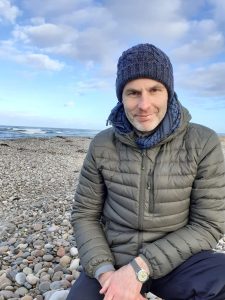
We are delighted to see a past colleague and friend join us as Technical Advisor. Lance brings with him a wealth of experience in the energy training sector from his time at Nautilus and more recently, TRACS International in Aberdeen. Based near Elgin in Scotland he will be key to exploring and delivering training business in the European market and driving forward new projects as GeoLogica continues to build a successful training business of the future.

GeoLogica would also like to highlight the upcoming Spring and Summer training courses on offer to you. We remain positive that fieldwork is a possibility for this year and have a range of courses available for you and your colleagues.

Lance Morrissey GeoLogica

GeoLogica 2021 Program and Update

GeoLogica’s initial 2021 program release consists of 21 Live Online Courses of varying duration – from short 6-hour fundamental and masterclasses, to full-length courses of up to 36 hours of training.

It has been a bumpy ride this year for the industry and the world at large. With the promise of at least one vaccine becoming available in the very near future, this turbulence will hopefully abate as we move into 2021. Looking forward to less challenging times, GeoLogica has been busy building a robust geoscience training program. Working closely with our contacts in the industry and our world-leading tutors, we have designed a program that addresses the industry’s needs for a combination of online training and some action in the field later in the year.

Our initial release consists of 21 Live Online Courses of varying duration – from short 6-hour fundamental and masterclasses, to full-length courses of up to 36 hours of training. To mitigate “screen fatigue” for all concerned, our Live Online Courses are taught in sessions limited to around 4 hours per day and we have also taken care to schedule our courses to be convenient for both US and EU attendees.

We are cautiously planning for a small program of field courses in the US and in the EU in 2021 and have provisional dates for 7 field courses. They will be subject to prevailing Covid travel restrictions and we will provide regular updates on the status of these in the coming months. Full refunds will be available if a field course is cancelled or if participants are unable to attend alternative dates.

As ever, we are on hand to provide customized training for individual companies. Our small team are able to work quickly and dynamically to develop courses and programs to suit companies’ needs and budgets.

We are developing more courses and we will be releasing updates as the program matures over the next few weeks, as well as announcing our plans for helping to educate business on the low and net-zero carbon economy – stay tuned for developments!

In more personal company news, we are really pleased to welcome two new members to our team:

Henry Mellors has joined GeoLogica to be our dedicated Health and Safety representative, responsible for ensuring both the HSE compliancy of prospective courses and the safe and smooth conduct of ongoing field courses a Field Safety Officer. A recent graduate with an honour’s degree in Outdoor and Adventure Education, his multidisciplinary training included group management, journey planning, technical rope skills and risk management, in addition to providing him with critical experience in a variety of outdoor settings in the UK and abroad.

Dave Waters has 25 years’ experience in industry geoscience – from majors to intermediates and small independents, and from the technical “coal-face” to team leadership roles. His current focus for us at GeoLogica will be to head up our GeoEnergy Transition training. More on this is to be announced soon but we are excited to be adding this category of training to our portfolio. Dave’s expertise in the field of energy decision making and his passionate interest in the future of geoscience in the coming energy transition, makes him the perfect person to push forward our vision of applying geoscience training to achieve a net-zero energy system.

With two new team members and a new 2021 program to shout about, all of us at GeoLogica are feeling positive about the future.

GeoLogica Cryptic Crossword

Try your hand at our cryptic crossword – answers to follow next week.

Let us know how you get on info@geologicaworld.com

Live Online Training Discounts

World-class geoscience training courses now available with a 50% discount for job seekers and students.

Our NEW Online Training Program for Fall 2020 is now live. Sensitive to the health and safety of our attendees and tutors, and to the financial challenges facing the industry this year, we have decided to deliver our public courses as online offerings. Online delivery ensures social distancing, eliminates the necessity for travel and is more cost-effective in these difficult times.

We have designed the program to be broad in its variety of subjects, with different levels and duration, in order to meet the varying needs, budgets and time constraints of our clients. The courses will be delivered by expert tutors through live seminars, typically three hours in length, over a number of days. They range from short courses consisting of two to three sessions, to longer and more comprehensive treatments of particular subjects that will take up to ten sessions to complete.

For the remainder of 2020, we are pleased to offer all Students and Displaced Professionals a 50% discount on all our live online classes.

Simply visit our upcoming courses page for further details on the courses available and use the promo code 50%2020-JOB at the checkout.

This offer is valid on all our live online courses for the remainder of 2020.

GeoLogica New Program for Fall / Autumn 2020

In response to the ongoing travel and economic challenges, GeoLogica are pleased to announce a NEW program for the Fall / Autumn 2020.

To address issues of potential exposure to Covid-19 and the budget constraints of our clients, the new Program will be delivered via Live Online Sessions. This mode of delivery eliminates the necessity for travel, minimizes social exposure and lowers course costs.

Ranging from 6 to 36 hours of tuition, the variety of online courses provides options for introductory, in-depth and workshop-like treatment of topics. The range of training topics has been widened and the scheduling has been carefully considered to provide variety and availability for both US and European audiences.

While the restrictions of the current climate have led us to defer our field courses until 2021, we recognize the importance of field training and are pleased to include a “virtual field course” in our 2020 line-up Virtual Field Seminar: Reservoir Characterization of Deepwater Systems, San Diego, California (V046).

We are excited to be launching this new program and to have the opportunity to work with a large number of world-renowned experts in topics such as salt tectonics, pressure prediction, AVO, fractured reservoirs and more.

Please visit upcoming courses for more information.

Energy and Power Density: the deepwater advantage

In the oil and gas industry, the size of a discovery matters. And these days, so does the environmental footprint of extracting its resources. As the world continues to research sustainable energy sources, one geologist – in a rare twist – is looking to giant deepwater oil and gas fields as part of the solution rather than as part of the problem. Based on an article by Heather Saucier that appeared in the April 2020 AAPG Explorer, this version was edited by Henry S. Pettingill and Dr Paul Weimer.

In the oil and gas industry, the size of a discovery matters. And these days, so does the environmental footprint of extracting its resources. As the world continues to research sustainable energy sources, one geologist – in a rare twist – is looking to giant deepwater oil and gas fields as part of the solution rather than as part of the problem.

“If we’re looking for efficient sources of energy with manageable environmental footprints, deepwater may be the place to look,” said Henry S. Pettingill, consultant and former geologist for Shell and Noble Energy. “While most of the media focus seems to be on the environmental strain related to consumption of energy, we should also consider the environmental cost of extracting and producing that energy.”

Pettingill is seeing deepwater oil and gas production in a more favorable light – both to the industry and to the environment. Most notably, about half the reserves of the deepwater giant fields are natural gas, which emits far lower emissions than coal or oil. Since there is abundant supply and the economics can be favorable, many see it as the bridge fuel between now and the day that renewables and safe nuclear can provide a more substantial portion of our global energy mix.

RESERVE DENSITY

Pettingill has been studying deepwater giant oil and gas fields, comparing their reserves to their surface areas, ranking them according to their “reserve density”, or their volume in hydrocarbons per square meter. ”Because hydrocarbon volumes are expressed in energy equivalents (e.g. barrels of oil equivalent or “boe”), reserve density is also energy density, and this allows us to visualize how much energy is concentrated in one place, and generally speaking, points to the level of economic and environmental efficiencies associated with extraction of those reserves.”

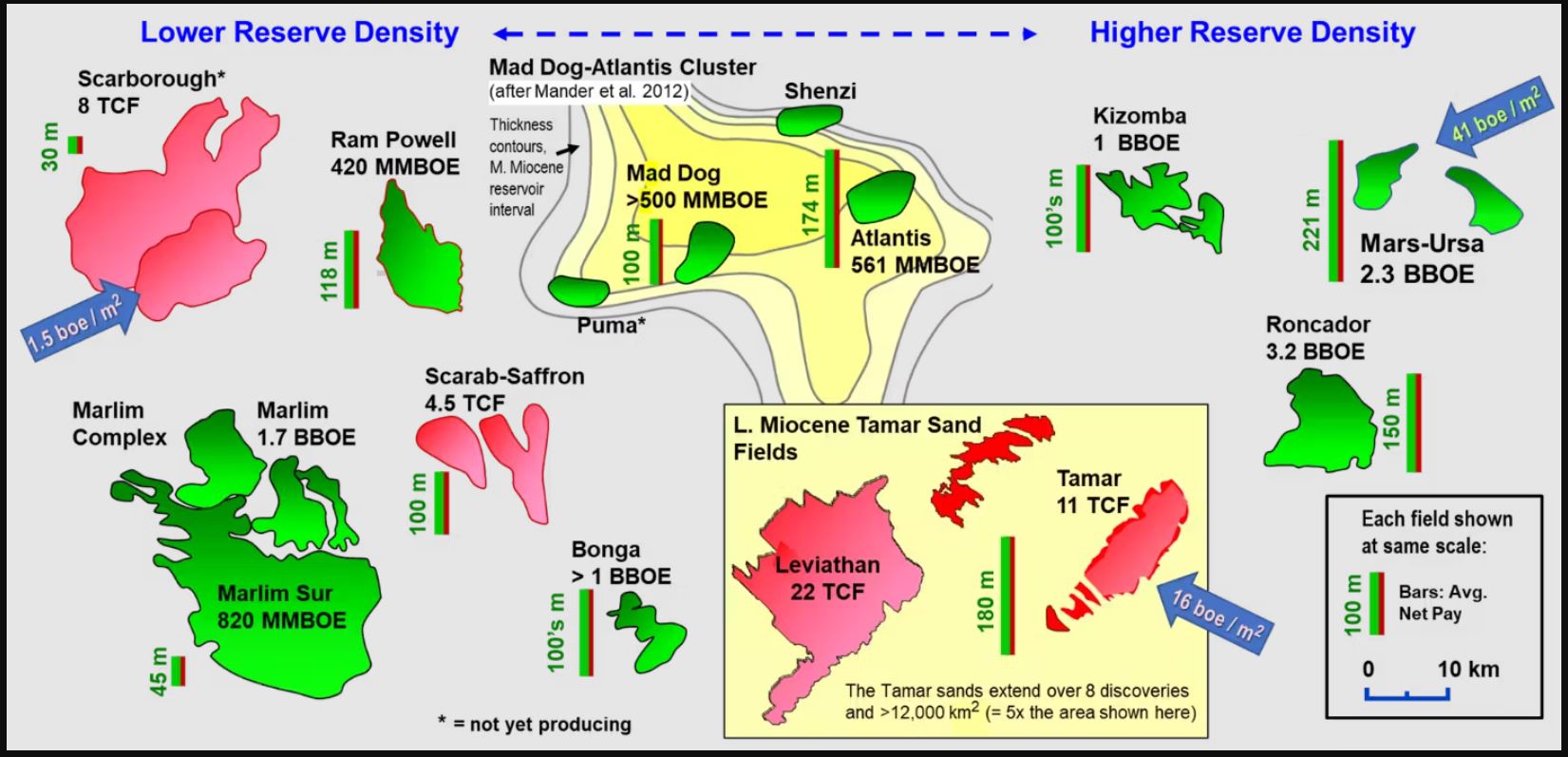
His first step was to produce a chart of the giant deepwater fields to determine which fields have the largest and smallest reserves per areal footprint (Figure 1). These fields were chosen because they represent the diversity in areal footprint and net pay thickness. From this visual technique, we can appreciate fields with vast areas but relative low net pay – “pancake-shaped” – from those with smaller areas but relatively large net pay – “pipe-shaped”, with the latter having higher reserve density. The Mars-Ursa complex in the northern Gulf of Mexico topped the list with an estimated 2.3 billion barrels oil equivalent contained within an area significantly less than 100 square kilometers, giving it a reserve density of about 40 barrels per square meter. The Mars field occupies an area smaller than most Houston neighborhoods, or about 70% of the area of Houston’s Bush Intercontinental Airport.

“Mars is a unique field,” said Dr Paul Weimer, who was Pettingill’s co-author in a presentation on the topic at the AAPG Global Super Basins Conference in February 2020. “It has a minimum of 14 reservoir levels in a very small area, and they are all stacked on top of each other.”

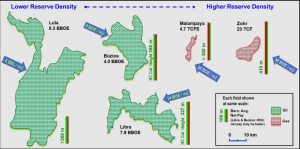
Figure 1: Areal footprints of select Giant Deepwater fields, along with their net pay thicknesses, all drawn at equal scale. Left: Field with Deep marine sand reservoirs. Right: Field with Carbonate reservoirs. Arrows denote the Reserve Density in barrels of oil equivalent per square meter (boe/m2).

Egypt’s Zohr gas field is close behind Mars, with more than 23 trillion cubic feet of recoverable gas distributed over an area of roughly 100 square kilometers, and a reserve density of about 38 barrels per square meter.

At the other end of Pettingill’s spectrum, the Scarborough gas discovery off the northwest coast of Australia has a reserve density of just 1.5 barrels of oil equivalent per square meter – its area spanning a vast 800 square kilometers, with recoverable volumes of 7.3 trillion cubic feet. Scarborough would occupy about half of the entire Houston metropolitan area. It is notable that this appraised discovery has yet to come onstream 42 years after discovery.
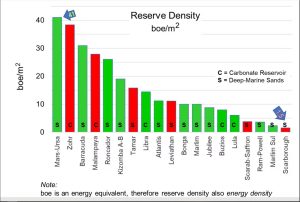
Figure 2: Reserve Density in barrels of oil equivalent per square meter (boe/m2).Red = Gas Fields, Green = Oil Fields (most with associated gas).

POWER DENSITY

Robert Bryce, in his 2010 book “Power Hungry”, defined power density as the amount of power that can be generated per square meter. Using the reserve densities of each field, Pettingill calculated their “power density”, in both watts and barrels of oil equivalent per day.

He then produced a power density chart comparing deepwater fields to a host of other power sources in a quest to learn which provided the most power and simultaneously took up the least amount of space (Figure 4).
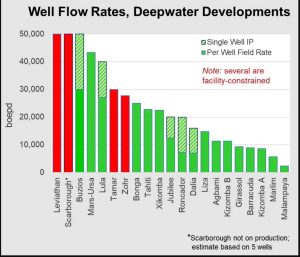
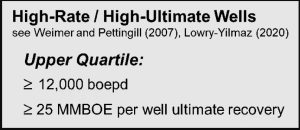
Figure 3: Flow rates from Deepwater fields. Since barrels of oil equivalent is an energy equivalent and power is energy per time, this is a comparison of the power output of individual wells.

The Mars-Ursa field is the standout example, delivering more than 500 watts per square meter. Also, impressive, Israel’s Tamar gas field, because it has a high reserve density and flow rate, produces about 100 watts per square meter.

In contrast, a typical two-reactor nuclear plant from South Texas produced 56 watts per square meter, while in 2010 the average onshore U.S. gas well produced roughly the same amount.

Farther down the efficiency line are sustainable energy sources. The average solar plant delivers about 7 watts per square meter, whereas wind farms deliver about 1 watt per square meter. At the lowest end, cornfields used for ethanol deliver less than one-tenth of a watt per square meter.

“Wind farms, solar energy and unconventional hydrocarbons require very large amounts of area per megawatt generated,” Pettingill said. “A deepwater field with a small footprint is much more economically and environmentally efficient.”

For example, to replace the Mars-Ursa power output with corn ethanol, an area about one-half the state of Texas would have to be covered in cornfields, he said.

And, unlike many shale plays – which often require an extensive pipeline network connecting many wells over many miles – offshore fields use limited pipelines and do not rely on a steady stream of trucks on the road to support drilling, hydraulic fracturing and production operations and in some cases oil evacuation.
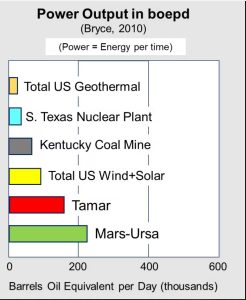
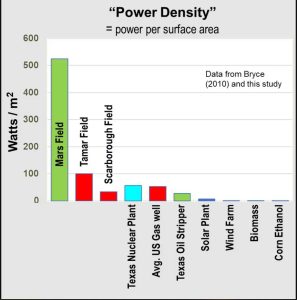
Figure 4: Left: Power Output of typical fuel sources used to generate power, including the Mars-Ursa Complex of the Gulf of Mexico deepwater and the Tamar gas field of the deepwater Levant basin. Right: Power Density of typical fuel sources, shown in comparison to the deepwater fields Mars (U.S. Gulf of Mexico), Tamar (Israel Levant) and Scarborough (Northwest Shelf, Australia)

Because deepwater is known for very high flow rates, hydrocarbons can be quickly pumped straight to a processing facility. “It gets to the user much faster, which in turn provides an economic advantage, with lower environmental burden from extraction than some other forms of energy,” Pettingill said.

Recalling his time at Noble Energy, he said, “The day we turned on the Tamar gas field, Israel was able to replace coal with natural gas as the primary feedstock to their power plants. Prior to that day, they never had a substantial reliable natural gas source, and now they are exporting gas.” Noble stated at a 2013 conference that “The amount of coal removed from Israel’s energy supply is the equivalent to taking every car off the highway in Israel for 17 years.”

He added that if Israel were to replace the power generation of the Tamar gas field with corn ethanol, then cornfields 11 times the area of Israel would be needed for the same amount of power.

Pettingill does acknowledge that offshore production can only be considered environmentally sound if strict measures are followed to prevent spills, leaks and damage to the seabed, and other forms of harm to wildlife.

In reflecting on the history of the industry, in which economics has always driven exploration and development, Pettingill suggests that reserve density and power density be factored into the equation, especially as the world gravitates toward projects that balance economic development with environmental needs.

“Oil and gas are still good. What we do matters,” he said. “We are delivering something that cannot be replaced in an economically competitive way. But the message here is that deepwater production is economically friendly and environmentally manageable.”

Pettingill teaches two courses with GeoLogica, one in the field and one in the classroom. His field course in the Pyrenees of Spain, Sand-rich Turbidite Systems: From Slope to Basin Plain (G016), examines the types of deposits that form the reservoirs in many of the fields discussed in this article. His classroom course is Creativity and Innovation Skills for E&P (G029). It is co-taught with Niven Shumaker and explores the types of “out of the box” thinking that Henry used to develop the energy density views presented above.

April, 2020

The GeoLogica Quiz 1 May 2020

Last week’s quiz went down so well, we’ve decided to do another one for this week!

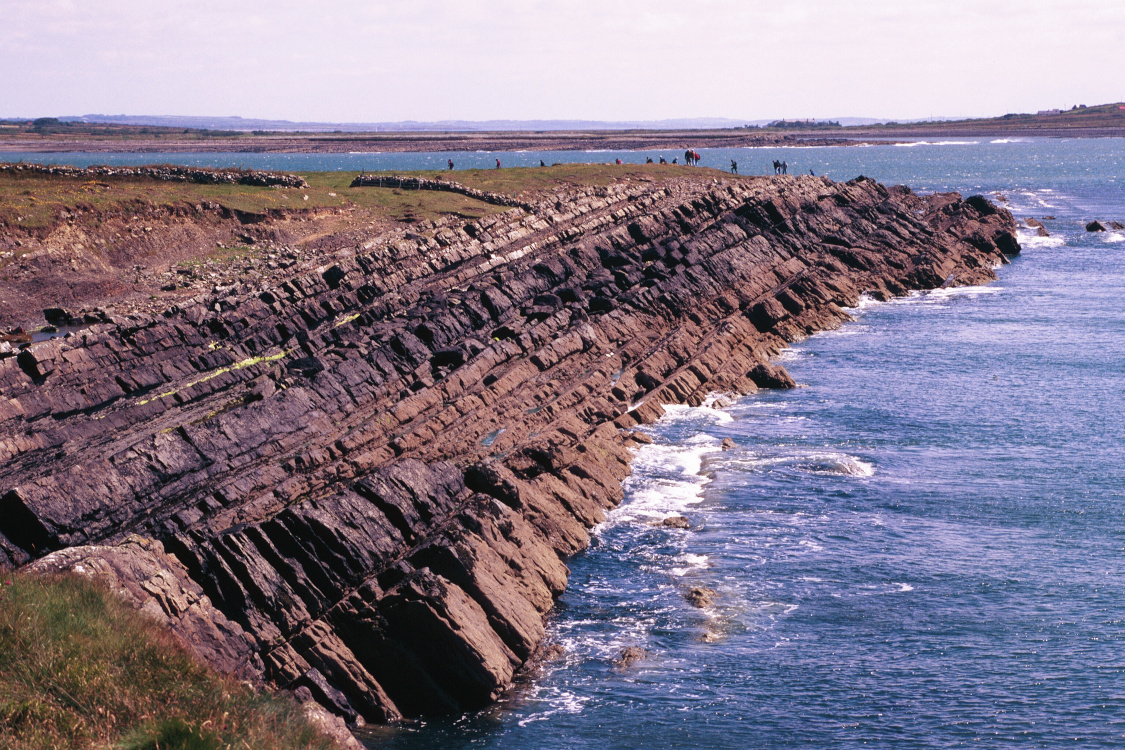
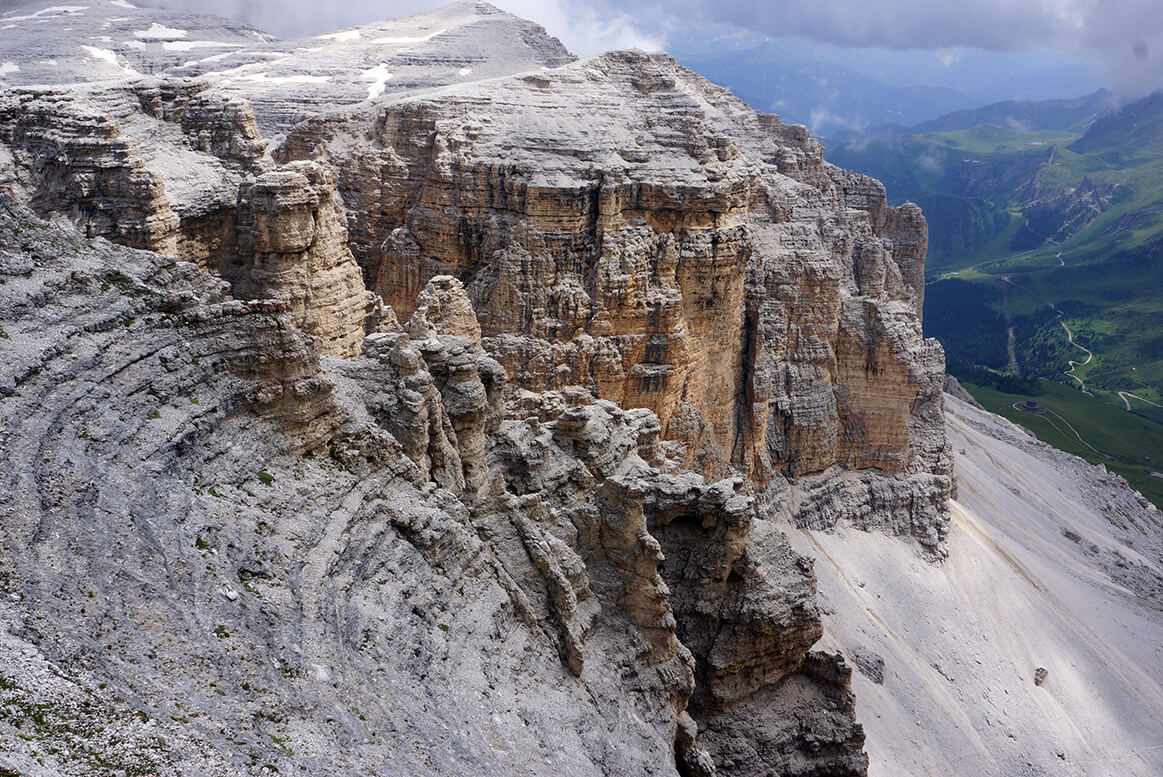
Q1. Where is this photo and what does it show geologically?

Triassic Dolomites Italy GeoLogica

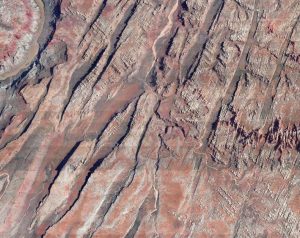
Q2. Where is the area shown below? What is the origin of the prominent linear landforms? Image courtesy Google Earth.

Q3. Solve the geological anagrams below:

A RIGHTS PARTY

SUPER COARSELY

TOXIN PAROLE

I SAIL FANCY SEAS

Q4. Geography clearly wasn’t the strong point of the producers of the film Krakatoa, East of Java but it’s also a line from a 1979 song by which band (named after a hairdo and an aeroplane)?

For a bonus point – when was the most recent serious eruption of Anak Krakatau?

Training in the Time of Corona

As the world continues to adapt to the restrictions imposed by the Coronavirus lockdown, training companies are having to investigate new ways to educate and engage clients. The lessons GeoLogica learn may provide new insight into how our business emerges in the post-Corona landscape.

For some years now portions of education, training and learning have been moving into the online realm, most notably through self-paced methods, including reading, pre-recorded lectures and quizzes, and these have proved useful for some fundamental topics. While we feel there is nothing better than direct interaction with an experienced instructor, in a world where direct interaction is off the table, we want to access the next best alternative.

We see a solution in remote delivery where the online teaching is live in real-time and combined with periods of self-paced learning through reading and quizzes. A key challenge will be to establish the optimal length for each element. Traditional lectures and meetings generally last no longer than an hour or so, in order for peoples’ attention to remain focussed – any shorter and the topic may not be sufficiently developed, any longer and concentration can wander. Online attention spans are thought to be considerably shorter – the ideal length of time for a talk or lecture may be only 30 minutes before breaking for a quiz, exercise or Q and A session. Live sessions could perhaps last 60–90 minutes if there are plenty of breaks and thought is given to issues associated with staring at screens for prolonged periods of time. Materials for self-paced learning also need to be thought-out – they should be well-structured and broken into smaller sections to tie-in with the live learning and ensure not too much is crammed into the time between lectures.

A key consideration for us is working with each instructor to find the model that works best for him or her. Some will prefer numerous short and punchy lectures, while others will opt for longer sessions that allow for more in-depth treatment of a topic. Some will rely heavily on interactive exercises and others on demonstrations. In every case, we want a solution that allows for live visual and audible feedback from course participants to maintain class momentum and enthusiasm.

Taking all these factors into account, GeoLogica is pleased to announce that we can offer online training as an in-house option for most of the courses in our portfolio. Topics range from Fundamental to Advanced courses in Basin Analysis, Resource Plays, Structural Geology, Geophysics, Evaluation Methods, Geophysics, Reservoir Characterization, Depositional Systems and Reservoir Engineering. Most of our courses can be tailored to fit an individual company’s needs and the delivery method can also be modified to suit. You can download a list of our latest online course offerings here or contact us with your requirements.

All of us at GeoLogica believe the most effective teaching is face-to-face – yes, it is more expensive but, in the end, people learn best through direct, human interaction and experience. Attending a classroom course with your peers and colleagues also provides an unquantifiable stimulus of human interaction, which helps develop a deeper understanding of the topic. And in the field, the full sensory immersion of observing outcrops provides an unbeatable learning environment. Nevertheless, there is a space for online leaning, so long as it is designed to be efficient, effective and engaging. Advantages can include reduced need for travel, less time away from the office for participants and cost savings. And, in these challenging times, social distancing.

‘Experiential’ learning, whether face-to-face or online, is thought to be fundamental to human understanding of the world around us. It is unlikely that online methods will completely replace traditional teaching methods but perhaps there is an optimum combination of online and face-to-face methods. Time will tell.

The GeoLogica Quiz 23 April 2020

To help divert you during the Lockdown we present the GeoLogica Quiz, a monthly smorgasbord of geological trivia. Answers in next week’s post!

Q1. Where is this outcrop and what does it show (relevant info on formation, age and structure)? Extra points awarded for interesting observations.

Q2. Where in the world is this Google Earth image and what does it show? (image courtesy of Google Earth)

Q3. Solve the four geological anagrams below:

IGLOO CAGE

STOLEN TACTICS

RECRIMINATIONS PIE TEST

VISCERAL ROT CRIES

Q4. A geocultural question – what catastrophic geological event occurred around 1600BC and how may it have affected human history?

New Ideas on the Timing and Paleogeography of Salt Deposition in the Gulf of Mexico: Mark Rowan

Mark Rowan discusses evaporite deposition in the Gulf of Mexico and how new ideas on its timing have important implications for both pre- and suprasalt exploration.

The Gulf of Mexico (GoM), despite being one of the most studied salt basins in the world, remains an enigma in terms of the timing and paleogeography of evaporite deposition. But new data and ideas are changing how we think about the deep framework of this prolific basin.

The salt has traditionally been considered to be Callovian (upper Middle Jurassic), but with effectively no supporting data due to suprasalt strata with no age control and a lack of presalt penetrations. Recently, though, Sr isotopes have yielded ages ranging over roughly 5 my from the Bajocian to the Callovian. Well data from the southern GoM onshore and shelf show that the cessation of evaporite deposition was gradational, with interbedded carbonates and anhydrite that continued into the Oxfordian and Kimmeridgian in a hypersaline sabkha environment with up to 3X normal ocean salinity. In coeval salt basins from onshore Mexico, Sr and biostratigraphic data indicate ongoing evaporite and minor carbonate deposition from the Bajocian through the Kimmeridgian.

Other traditional views are that the salt was deposited near sea level and that the salt was almost pure halite. But these are being challenged by new ideas triggered in large part by the much improved imaging provided by modern seismic data. More researchers are coming around to a model in which the salt basin had considerable relief, ranging from close to sea level in proximal areas to 2 km or more in the basin center. However, whether the basin was filled mostly with brine or mostly with air is still a matter of debate. Moreover, the salt appears to be a typical layered evaporite sequence with at least locally significant proportions of non-halite lithologies. This can be seen in folded intrasalt layers within the cores of deep anticlines in the NW and SW GoM and in the “Sakarn” series in the NE GoM (with an equivalent offshore Yucatán), a deformed layered sequence coeval with at least part of the Louann/Campeche salt.

These new ideas have critical implications for subjects ranging from both pre- and suprasalt exploration, to plate tectonics and Jurassic paleogeography. They, along with the fundamentals and styles/processes of salt tectonics, will be addressed in Salt Tectonics of the Gulf of Mexico, the GeoLogica course running in Houston from 13–14 August, 2024.