Tutor
Dr. Eric C. Gaucher: Lavoisier H2 Geoconsult
Overview
In the rapidly evolving field of natural hydrogen, mastering geochemical modeling is a critical asset for any technical team. This course will give participants the skills to undertake the numerical modeling of water-rock-gas systems and become familiar with the widely-used PHREEQC software package. You will receive debugged and optimized PHREEQC scripts and the specific LH2G methodology for water chemistry quality control. This allows your team to save weeks of in-house development and avoid costly modeling errors.
Duration and Logistics
Classroom version: A 4-day course including case studies, exercises, and practical work on a variety of waters and H2 generation systems. The exercises become more complex to allow for a step-by-step approach. The course can be given at your office, or for those wanting an out-of-office experience in Europe, the course can be delivered in Chamonix, France.
Level and Audience
Intermediate. The course is largely aimed at geoscientists, hydro-geochemists, hydrogeologists or process engineers wishing to acquire skills in geochemical numerical modeling. You will be required to have a basic knowledge of chemistry, geochemistry and fundamental notions of thermodynamics.
Objectives
You will learn to:
- Evaluate water chemistry and correction of the chemical composition.
- Calculate the speciation of an aqueous solution and simulate water/rock/gas interactions in open or closed batch systems.
- Model the evolution of fluid composition as a function of temperature, pressure and salinity.
- Assess the chemical composition of a fluid during dissolution/precipitation of solid phases.
- Characterize how hydrogen is generated from various rock types.
Tutor(s)
Eric Gaucher: CEO, Lavoisier H2 Geoconsult and RockyH2.
Jean Gaucher: Development Officer, Lavoisier H2 Geoconsult.
Overview
The last few years has seen a growing interest in natural hydrogen accumulations. We know that there are a variety of processes that can lead to hydrogen being produced in the Earth’s crust but there is much still to understand about these, how much is perhaps present in subsurface stores and where these accumulations are. Commercial exploitation will also need to assess the engineering challenges for extracting this hydrogen and ultimately how best it can be utilised as part of the changing face of our modern energy landscape. This course will give an integrated view on the economic, strategic and scientific aspects of natural hydrogen exploration and its perspectives.
Duration and Logistics
Virtual version: Four 3.5-hour online sessions presented over four days comprising a mix of lectures, exercises, case studies and discussion. The course manual will be provided in digital format.
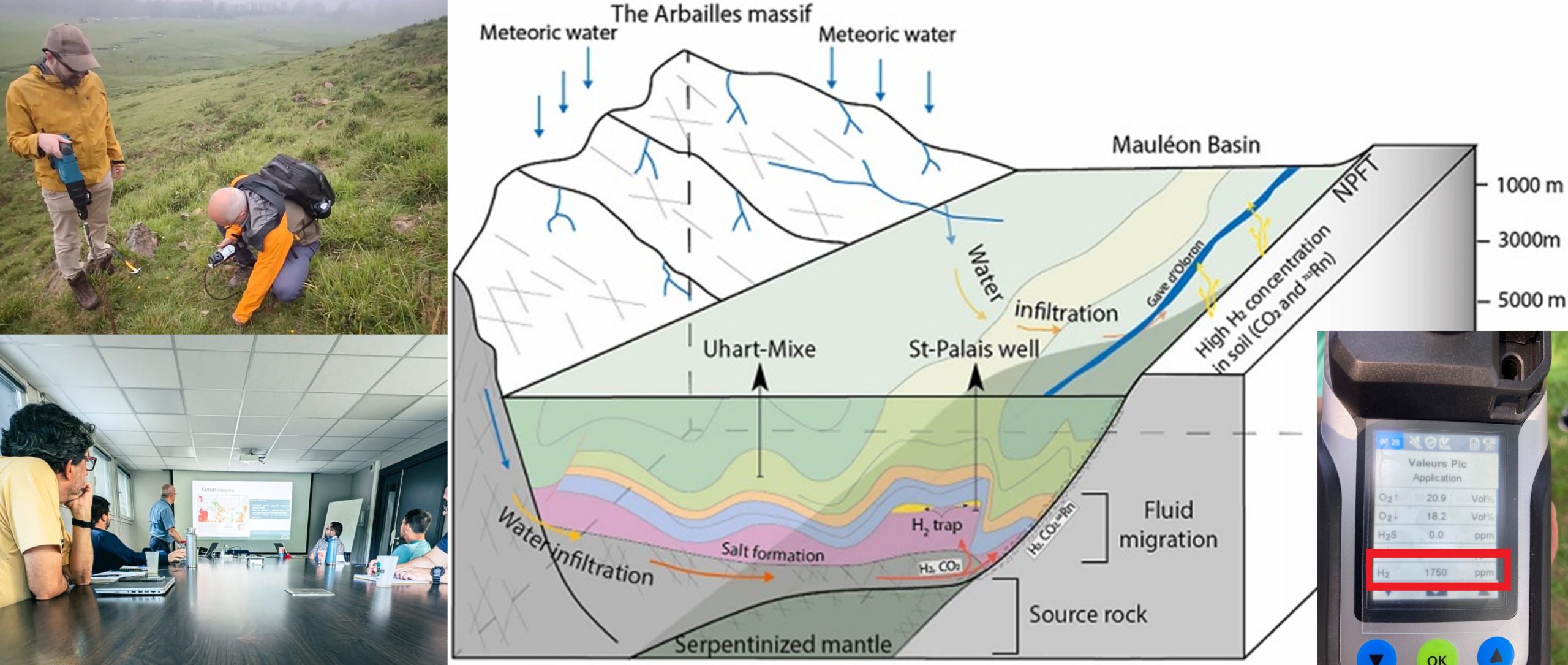
Fieldtrip version: A 5-day field course located in Pau, France with a focus on the geological aspects of natural hydrogen.
Level and Audience
Fundamental. The course is largely aimed at geologists interested in natural hydrogen occurrences but the trainers able to adapt the level of the course to the requirements of the attendees.
Exertion Level
This class requires and EASY exertion level. Travel is by small coach and there are hikes of less than 10 minutes in duration (less than 1 km) on well-graded terrain in the foothills of the Pyrenees.
Objectives
You will learn to:
- Evaluate the different types of hydrogen and the origins of natural hydrogen.
- Characterise the strategies for the exploration of natural hydrogen.
- Clarify and organize the different technical steps of a natural hydrogen exploration programme.
- Appraise the geological, geochemical and geophysical tools that can be used for natural hydrogen exploration.
- Assess the co-production of natural hydrogen with geothermal resources, Helium and the mining industry.
- Assess the techno-economic evaluation of natural hydrogen.