

Tutor(s)
Peter Hennings: Consulting Geologist and Research Scientist and Lecturer, UT Austin, Texas.
Overview
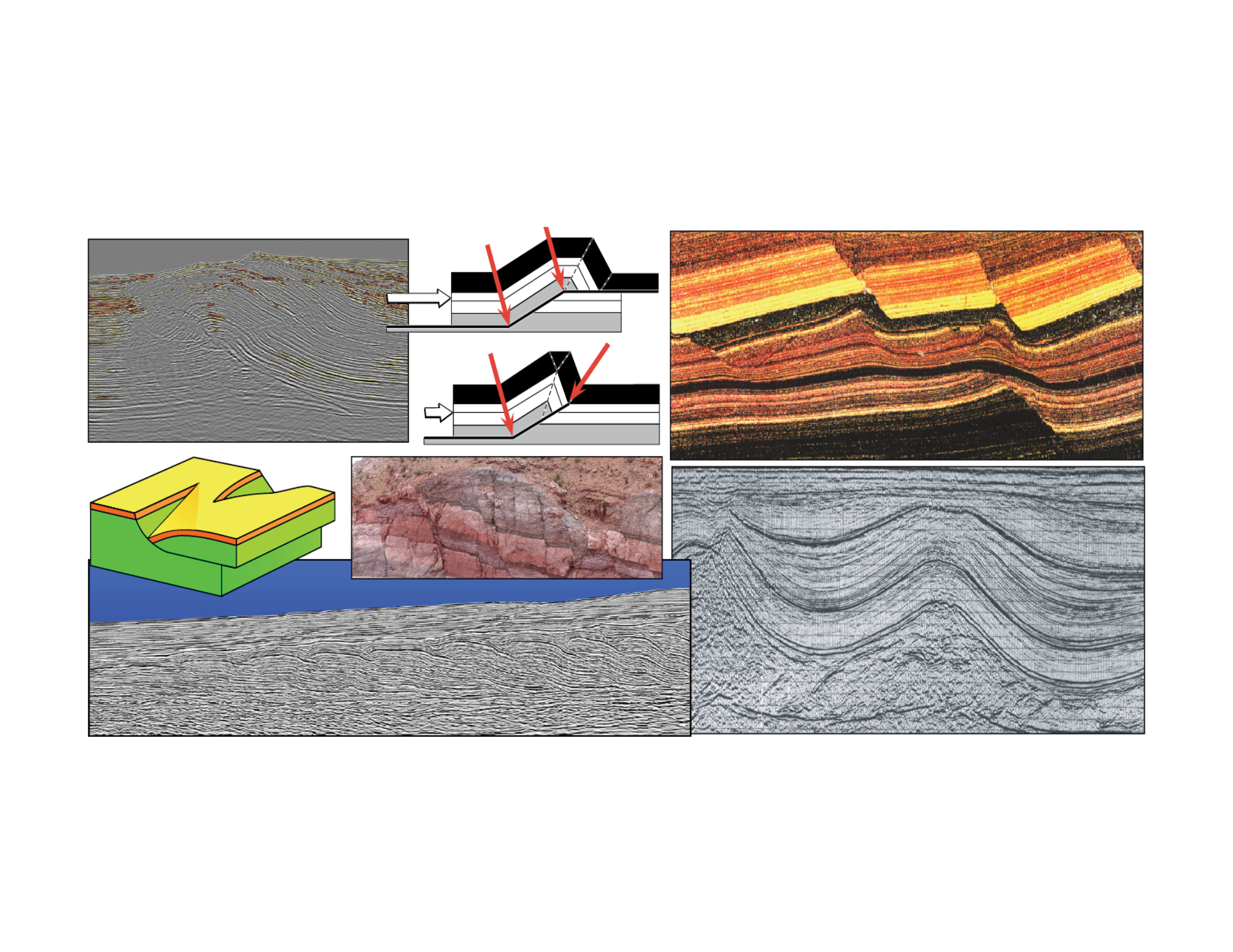
The course addresses interpretation of 2-D and 3-D seismic reflection data for unraveling the geometry and kinematic evolution of crustal structures, principally in sedimentary rocks. Topics include understanding how structures manifest themselves in seismic data and approaches to effective interpretation and kinematic analysis. Structural systems addressed include extensional, fold and thrust belts, salt tectonics and inversion. Applied topics include interpretation and analysis approaches, determination of geologic and basin history, fault system analysis, fault permeability structure and geomechanical evaluations, such as in situ stress determination and application to induced seismicity risking. Practical exercises are based on global seismic datasets and are reinforced by active in-class discussion.
Duration and Logistics
Classroom version: A 5-day classroom course, comprising a mix of lectures (40%), analysis of case studies (30%) and integrated exercises (30%). The manual will be provided in digital format and participants will be required to bring a laptop or tablet computer to follow the lectures and exercises.
Virtual version: Ten 3.5-hour interactive online sessions presented over 10 days. A digital manual and exercise materials will be distributed to participants before the course. Some reading and several exercises are to be completed by participants off-line.
Level and Audience
Fundamental. The course is intended for geoscientists who wish to strengthen their seismic interpretation and analysis skills by applying key interpretation techniques and strategies to a wide range of structural types and application goals.
Objectives
You will learn to:
- Understand the manifestation of 3-D structures in reflection seismic data.
- Develop effective structural interpretation perception – learning to think ‘kinemechanically’.
- Generate interpretations with geometric admissibility and kinematic compatibility.
- Understand imaging scale, artefacts and interpretation pitfalls.
- Gain experience in interpretation and analysis in all structural regimes.
- Understand how faults form, grow, interact, reactivate and impact fluid flow.
- Gain an introductory understanding of geomechanics as applied to interpretation.
- Become acquainted with fault stress analysis and fault seal risking.